


By Brian McCracken, AI Strategy Expert at The Provato Group, combining AI/machine learning and frontend development to create intelligent, discoverable web experiences.
September, 2025
It seems like everyone wants AI to be a part of their business model. They aren’t always sure how it fits in with their operations, but they know they want it.
I’ve found that many businesses are afraid their competition might do something with AI that makes their entire product line obsolete overnight, or worse. When I ask what the worst is, I rarely get a real response, and that’s okay. The takeaway is always the same; business leaders don’t want to be left behind.
Unfortunately, what sometimes occurs is they will begin implementing new features or systems, not really understanding how they work just to say they have AI. But that can go wrong. Terribly wrong in fact.
Imagine this.
It’s 8AM. Your customer service manager calls you in a panic. Your team implemented a new AI chatbot for customer support that you didn’t fully understand, and it seemed to be working great. You thought. Unfortunately, you didn’t really understand what it was doing under the hood, or how it was making decisions.
Come to find out, that new AI chatbot spent the whole weekend telling customers that your flagship product causes cancer. It doesn’t, but there was a random Reddit thread in your training data and the chatbot was trained to believe that someone’s sarcastic joke was fact.
Three news outlets have picked up the story. Your stock is down 12%. Your CFO asks how this happened, and you can’t answer them.
Meet Bob. He shipped a feature he couldn’t explain.
We help you ship the ones you can.

Now, of course, this is a made up scenario, but these things can happen when leadership doesn’t understand what they are buying when investing in AI.
The chatbot that caused this crisis? It’s powered by something called an AI model. If you want to avoid playing Russian roulette with your brand, it’s important to understand how they work.
What Is an AI Model?
An AI model is a computer program that has gone through either supervised, unsupervised, or reinforced training to identify patterns in large datasets and produces predictions, classifications, or decisions with minimal human involvement. It uses a variety of algorithms to learn from the patterns in the data it is provided, and applies what it learns to new data that it hasn’t been previously trained on.
It helps to think of an AI model like teaching a child to recognize animals. If you show them pictures of cats and dogs, the child will learn the difference between them and then can later pick out cats and dogs in pictures that they’ve never seen before. The same goes for AI models. Once trained, when given new information it will produce an output based on what it previously learned.
How Do AI Models Work?
AI models work through a four step process:
- Data Collection: Raw data is gathered from various sources. This data matches the type of data that the mode will later have to make predictions based on. It can be text, images, IoT sensor readings, etc.
- Data Preprocessing: After the data is collected it must be cleaned, labeled, and transformed into a usable training format for the AI model.
- Model Training: Model training is where the AI learns to detect patterns, correlations, and relationships from the collected data. Training is done via algorithms, neural networks, pattern identification, or learning from examples.
- Inference: Once an AI system has been trained it can make predictions or decisions from new, previously unseen data. In the case of generative AI, it can create entirely new content like text, images, or audio.
What Are the Main Characteristics of an AI Model?
The main characteristics of an AI model are that it is autonomous and able to make predictions on its own, that it learns from data rather than using explicit logic, it has task specific expertise, and loosely mimics human cognition. AI models are designed to think in a similar manner as humans, just much faster and with vastly superior pattern recognition capability.
The main characteristics of AI models can be different depending on the type of model being used.
| Model Type | Key Characteristics | Common Applications |
|---|---|---|
| Supervised Learning | Trains on datasets where both the input features and desired outputs are known. Relies on accurate, well-labeled examples. | Spam filtering, medical diagnosis models, demand forecasting. |
| Unsupervised Learning | Works with unlabeled data to uncover patterns, groupings, or hidden structures. | Market segmentation, fraud anomaly detection, product recommendations. |
| Reinforcement Learning | Learns strategies by interacting with an environment, improving performance through trial and error. | Autonomous robotics, strategy-based games, supply chain optimization. |
| Deep Learning | Employs layered neural networks capable of extracting complex features from massive datasets, especially unstructured content like images, audio, or text. | Facial recognition, voice assistants, real-time language translation. |
| Generative AI | Learns from existing data patterns to produce entirely new content. | Chatbots powered by LLMs, AI image creators, automated content summarization. |
Can AI Models Make Mistakes?
Yes, AI models can make mistakes. Typically, the errors produced by AI models are caused by poor train data quality, algorithmic constraints, or ambiguous inputs. The 2020 paper ‘Artificial Intelligence Is Stupid and Causal Reasoning Will Not Fix It’ by Bishop, J. found that AI models can make mistakes due to their inability to understand causality or grasp basic concepts like time and space.
The most common types of mistakes that AI models make are:
- Hallucinations: Plausible but false or fabricated information produced by generative AI models.
- Bias Outcomes: When an AI model has been trained on biased data, it may unintentionally make unfair predictions or decisions due to issues in the original training corpus.
- Misinterpretations: AI models can occasionally provide incomplete or inaccurate answers due to omitted information, incorrectly interpreted intent, or entity misidentification.
- Context Loss: In multi-step workflows or conversations, the AI model may lose track of context, which will lead to erroneous or disconnected responses.
How AI Models Are Created
AI models are created through a process that starts with a structured series of AI project discovery workshops. Those workshops will clearly define the problem or goal, gathering and labeling initial training data, choosing the right machine learning algorithms and tools, training the model, and evaluating it’s performance to determine if it is ready for real-world use. Continuous monitoring and updates over time will be needed to fine-tune the model iteratively, improving it’s accuracy over time.
-
Defining The Problem
In order for an AI model to be created, its goal, or the specific task it needs to complete must be clearly defined. The problem must consider business context, classification, inputs and outputs, and KPIs to measure results.
-
Collecting Training Data
A large amount of high-quality data that directly relates to the problem you’re trying to solve needs to be collected from varying sources and preprocessed to make it usable for the AI model.
-
Choosing Algorithms and Frameworks
An appropriate machine or deep learning algorithm will need to be selected based on the problem and the characteristics of the data used. Frameworks such as TensorFlow or PyTorch offer flexible and scalable model training.
-
Model Training
The chosen algorithm must be provided the preprocessed, cleaned, and structured data for training. In some cases, data will have to be tokenized beforehand in order for the model to process it.
-
Performance Evaluation and Optimization
The trained model’s accuracy and performance need to be measured using metrics that align with the problem the model was built to solve. The model’s parameters will then needs to be modified and adjusted to achieve the ideal outcomes.
-
Deploy, Monitor, and Update
The newly created AI model will need to be integrated into it’s host application or workflow. It’s performance should be regularly monitored to detect degradation and update for ongoing accuracy.
How Often Are AI Models Updated?
AI models are updated on varying schedules ranging from daily to annually depending on the application’s needs, rate of changes to the data, and resource constraints. Higher risk applications, such as those for cybersecurity, will often see much more frequent update cycles to evolve with changing intelligence while high-stakes applications such as healthcare will normally see fewer updates to maintain stability and validation.
Common Update Strategies
| Update Strategy | Typical Frequency | Use Cases |
|---|---|---|
| Periodic Retraining | Daily, weekly, monthly | Common in industry, balances performance and cost |
| Event/Drift-Triggered | As needed (on drift) | When data distribution changes significantly |
| Online/Continuous Learning | Real-time or near real-time | For streaming or rapidly changing data |
| Ad Hoc/Manual Updates | Irregular | When performance drops or new data is available |
Can I Create My Own AI Model?
Yes, you can create your own AI model, but depending on the application, it will normally make more sense to hire a developer who specializes in AI model creation.
Key Considerations
Are You Able To Collect, Clean, and Prepare Data Properly?
Research has shown that data quality is likely the single most important factor when creating an AI model. The 2022 paper ‘Advances, challenges and opportunities in creating data for trustworthy AI’ by Weixin Liang found that data design, sculpting, and evaluation are foundational for the creation of reliable AI models. If you’re unable to do this confidently, any attempt to create your own AI model may be wasted effort.
Are You Able To Ensure The Security and Privacy of Your Data?
AI models may unintentionally leak sensitive information such as personal information on your customers or their transaction history. There are also risks of data poisoning, model theft, and backdoor attacks that come with AI model creation and deployment. If you’re unsure of how to defend against those threats, it is advisable to hire a firm that does.
Can You Integrate An AI Model on Your Own?
After your create an AI model, you will have to integrate it for your business purposes. AI integration can be a daunting task unless you are a developer and understand the ins and outs of your business application and it’s workflows. If your attempted integration goes wrong, you could end up creating instability in your business operations that would be avoided by hiring a development firm.
How To Hire an AI Development Company?
To hire an AI development company you need to identify your business goals for the project, specify any technical requirements you may have (if any), source and screen candidates, and finalize an agreement. When looking for AI development services it’s important to assess their problem-solving skills, carefully gauge their communication and collaboration style to be sure it matches your culture, and look for real-world experience in solving problems like yours.
Can a Custom AI Model Be Developed for Just My Needs?
Absolutely! Custom AI model development is often needed by companies that require specially trained algorithms to handle problems requiring a high degree of accuracy, specialized integration or scaling requirements, or need a differentiating competitive edge that a generalized solution is unable to deliver.
Generally speaking organizations that are high-stakes, regulated, or use unique data and workflows are more likely to be innovators and early adopters in the AI space and require custom model development. These companies often have specific data or problems that pre-trained models are simply unable to address effectively.
How Much Does AI Model Cost?
The cost of a new AI model can range from $10,000 to $500,000+ depending on needs, size, and complexity. Here’s a breakdown of some estimates for budget planning:
| Project Type | Typical Cost Range (USD) | Description / Examples |
|---|---|---|
| Basic AI Features | $10,000 – $50,000 | Chatbots, rule-based systems, simple automation with pre-built models and APIs |
| Mid-Complexity AI Solutions | $50,000 – $250,000 | Custom ML models, predictive analytics, basic generative AI (MVP level) |
| Advanced / Enterprise AI | $150,000 – $1,000,000+ | Large-scale generative AI, multi-modal AI, full integration into critical systems |
| Custom Generative AI Features | $50,000 – $500,000+ | Text/image/code generation, fine-tuned domain-specific AI models |
How Many AI Models Are There?
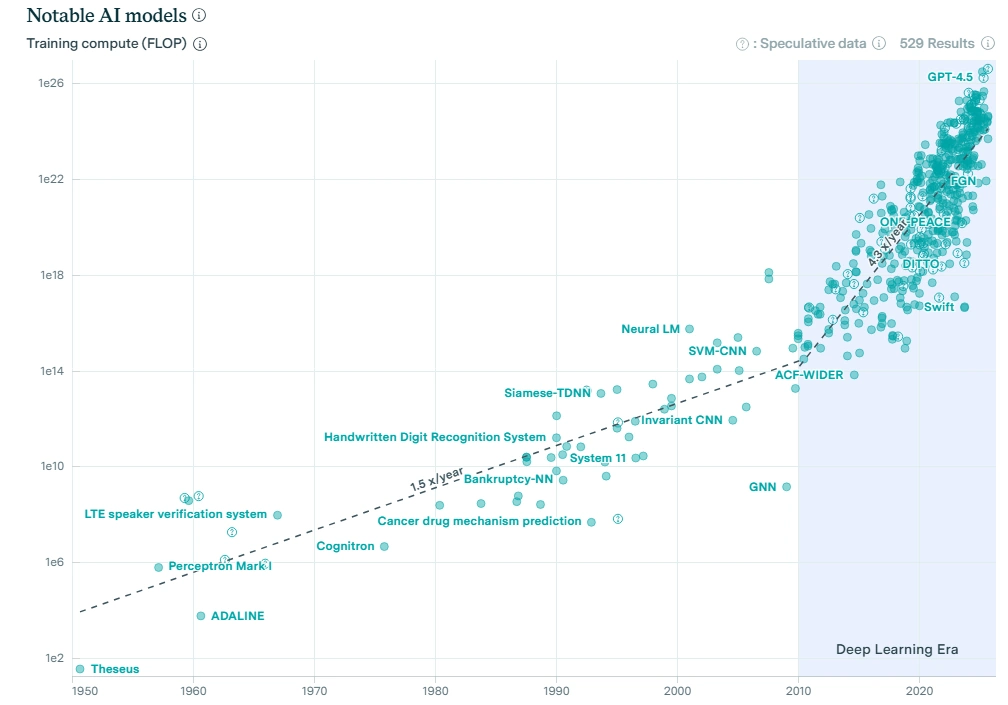
There is no definitive count of all AI models because new models are being released weekly, and the term model can be interpreted in different ways. As of September 2025 Epoch AI is tracking over 2,971 AI models in their database, but the actual number is likely much higher.
Here’s a breakdown as of September 2025:
- 529 “Notable AI Models
- 131 “Frontier” AI Models
- 294 “Large Scale” Models
Which AI Model Is Best?
Which AI Model Is Best for Coding?
Based on an analysis of benchmark performance, features, and user feedback, the best all-around AI model for coding in 2025 is Anthropic’s Claude Sonnet.
An effective evaluation of AI coding tools requires analysis of use cases, integration capabilities, The model’s capacity for contextual understanding, and the specific nature of the coding tasks it is meant to address.
Checklist for Selecting an AI Coding Model
- Code Accuracy
- IDE Workflow
- Context Window Size
- Debugging Ability
- Data Privacy
Checklist for Special Features
- IDE Assistants
- Conversational Coding
- Specialized Coding Models
AI Coding Model Benchmark Comparison
| Model | Provider | Type | HumanEval+ (pass@1) | MBPP+ (pass@1) | SWE-bench Verified (pass rate) | Key Differentiator |
|---|---|---|---|---|---|---|
| Claude 3.5 Sonnet | Anthropic | Conversational | 92.0% | 79.4% | 50.8% | State-of-the-art code accuracy and large context window. |
| GPT-4o | OpenAI | Conversational | 90.2% | 90.7% | 44.9% (diff) | Strong all-around reasoning and conversational debugging. |
| Gemini 2.5 Pro | Conversational | 83.3% | N/A | 63.8% | Massive context window for whole-codebase analysis. | |
| GitHub Copilot | GitHub / OpenAI | Integrated | N/A (based on OpenAI models) | N/A | N/A | Unmatched IDE integration and workflow smoothness. |
| Llama 3.1 (405B) | Meta | Open-Source | N/A | N/A | N/A | Full customization, privacy, and on-premise deployment. |
| DeepSeek-Coder-V2 | DeepSeek AI | Open-Source | 82.3% | N/A | N/A | Top-tier open-source performance on benchmarks. |
Which AI Model Is Best for Writing?
For writing, especially professional and long-form content where the quality is the most important factor, Anthropic’s Claude Sonnet is the best model available.
Picking an AI model for professional or creative writing will often come down to a trade-off between content quality and feature availability.
Checklist for Selecting an AI Writing Model
- Prose Quality and Naturalness
- Long-Form Coherence
- Creative and Ideation Capability
- Task-Specific Versatility
- Workflow Integration and Feature Set
Checklist for Special Features
- Deep Research Capability
- Tooling Variety
- Ability To Adapt Tone and Style
AI Writing Model Feature Comparison
| Model / Platform | Best For | Prose Quality | Context Window | Key Features | Pricing Model |
|---|---|---|---|---|---|
| Claude 3.5 Sonnet | Long-form, Professional Writing | Exceptional, human-like, nuanced | 200,000 tokens | Large document analysis, strong summarization | Freemium / Subscription ($17/mo+) |
| GPT-4o | Creative Ideation, Versatile Content | Versatile, creative, can be generic | 128,000 tokens | Image generation, web browsing, custom GPTs, voice mode | Freemium / Subscription ($20/mo) |
| Gemini 2.5 Pro | Research-based Writing | Direct, less “flowery,” analytical | 1,000,000+ tokens | Deep Research feature, Google ecosystem integration | Freemium / Subscription ($19.99/mo) |
| Jasper | Business & Marketing Copy | Good (depends on underlying model) | Varies | Brand voice, SEO tools, templates, team collaboration | Subscription ($49/mo+) |
| Sudowrite | Fiction & Creative Writing | Good (custom model for prose) | Varies | Plotting tools, character brainstorming, descriptive enhancers | Subscription ($19/mo+) |
Which AI Model Is Best for Math?
For state of the art performance on the most challenging math problems, Google’s Gemini 2.5 Pro is the leader.
Large language models have a known problem. They are not reliable calculators. They can often determine the logical steps to take, but fail at the final computation. They often need to rely on techniques such as Program-Aided Language Models (PaL) to handle this problem in their reasoning engine.
Checklist for Selecting an AI Math Model
- Accuracy on Complex Problems
- Calculation Reliability
- Explanation Clarity
- Problem Interpretation
- Versatility
Checklist for Special Features
- Hybrid Reasoning and Calculation Engines
- Problem Translation
- Math-to-code Pipelines
| Model / Tool | Primary Methodology | MATH Score (0-shot CoT) | GSM8K Score | Strengths | Limitations |
|---|---|---|---|---|---|
| GPT-4o (with ADA) | Code Execution | 76.6% | >92% | Verifiable, avoids arithmetic errors, versatile. | Dependent on prompting for code generation. |
| OpenAI o1 | LLM Reasoning (Iterative) | N/A | N/A | State-of-the-art on competition math (IMO). | Very slow and expensive, not for general use. |
| Gemini 2.5 Pro | LLM Reasoning | >86% (AIME) | >90% | Top-tier pure reasoning on advanced benchmarks. | Can make arithmetic errors, less verifiable. |
| Claude 3.5 Sonnet | LLM Reasoning | 71.1% | 96.4% | Strong on visual and multilingual math. | Lags on standard MATH benchmark. |
| Mathos AI | Symbolic Solver | N/A | N/A | High accuracy, excellent step-by-step solutions. | Not a conversational LLM, limited to solving. |
| Wolfram Alpha | Symbolic Solver | N/A | N/A | Gold standard for computational accuracy. | Lacks natural language understanding. |
Which AI Model Is Best for Image Generation?
The best AI image generator is a tie between Midjourney and DALL-E 3.
Midjourney remains the best choice for artists, designers, and creatives who need the highest possible artistic quality from their AI model while DALL-E 3 is the better choice to most business and casual users who will benefit from an easier to use conversational interface.
Checklist for Selecting an AI Image Model
- Aesthetic Quality or Photorealism
- Comprehension and Adherence to User Prompts
- Ease of Use
- Control / Customization
- Commercial Viability / Ethical Implications
Checklist for Special Features
- Artistic Expression
- Enterprise Tooling
- Commercial Safety
| Model | Photorealism / Artistic Quality | Prompt Adherence | Customization & Control | Commercial Safety / Ethics |
|---|---|---|---|---|
| Midjourney | Very High | Medium | High | Low (Public by default) |
| DALL-E 3 / GPT-4o | High | Very High | Low | Medium (Censored) |
| Stable Diffusion | Varies (High with effort) | Varies (Medium with effort) | Very High | Medium (User responsibility) |
| Adobe Firefly | Medium | Medium | Medium | Very High (Indemnified) |
| Imagen 3 | High | Very High | Low | Medium (Censored) |
Which AI Model Is Best for Research?
The single best AI model for all around research needs is Google’s Gemini 2.5 Pro with Deep Research.
AI models that perform research aren’t monolithic systems, but rather a collection of tools. Their roles are equally diverse, from models that just augment human research to other agentic models that completely replace the user when it comes to tactical research execution.
Checklist for Selecting an AI Research Model
- Factual Accuracy
- Source Citation
- Depth of Synthesized Conclusions
- Scope of Access
- Integration Capabilities
Checklist for Special Features
- Agentic Capabilities
- Research Strategy Planning
- Structured Reporting
| Tool | Best For | Primary Function | Level of Autonomy | Citation Quality |
|---|---|---|---|---|
| Perplexity AI | Quick, fact-based answers | Answer Engine | Low (User-directed search) | High (Direct links) |
| Elicit | Academic literature reviews | Lit Review Assistant | Low (Automates paper extraction) | High (Academic sources) |
| Consensus | Scientific fact-checking | Fact-Checking Assistant | Low (Summarizes existing research) | High (Peer-reviewed papers) |
| ChatGPT (w/ Browsing) | Synthesizing web & docs | Generalist Assistant | Medium (Executes user commands) | Medium (Can hallucinate sources) |
| Gemini (Deep Research) | Comprehensive topic overviews | Agentic Research | High (Autonomous planning & execution) | High (Web sources) |
Which AI Model Is Best for Data Analysis?
The best overall AI Model for Data Analysis is GPT-4o with its Advanced Data Analysis feature.
AI models have democratized data science, extending the accessibility of analytics to non-coders. Leading solutions are differentiated by they interfaces, workflows, and technical capabilities.
Checklist for Selecting an AI Data Analysis Model
- Accuracy
- Visualization Quality
- Data Comprehension
- Ease of Use
- Data Handling Scalability
Checklist for Special Features
- Automatic Data Cleaning
- Descriptive Statistics Calculation
- Built-in Code Execution
| Model | Core Feature | Supported File Types | Interactive Visualizations | Max Context / File Size | Code Transparency |
|---|---|---|---|---|---|
| GPT-4o | Advanced Data Analysis (Code Executor) | Excel, CSV, PDF, JSON, etc. | Yes (Limited types) | 10 files per conversation | Yes (Full Python code visible) |
| Claude 3.5 Sonnet | Analysis Tool (Interactive Artifacts) | CSV, PDF, etc. | Yes (Primary strength) | 200,000 tokens | Yes (Code visible in Artifacts) |
| Gemini 2.5 Pro | Long-Context Processing | Text, Code, Image, Audio, Video | Yes (via code generation) | 1,000,000+ tokens | Yes (via code generation) |
Which AI Model Is Best for Financial Analysis?
In this case, an AI model isn’t the best choice, but a platform is. AlphaSense combines complex workflows, purpose-built tools, and built-in transparency.
Generalist tools are capable of processing and summarizing financial documents, but lack access to trusted financial data sources to be the best choice.
Checklist for Selecting an AI Financial Analysis Model
- Data Source Quality
- Quantitative Accuracy
- Auditability and Transparency
- Security
- Compliance
Checklist for Special Features
- A Data-Fabrics Approach
- Private Data Sources
| Tier | Representative Tools | Best For | Key Data Sources | Strengths | Limitations |
|---|---|---|---|---|---|
| Tier 1: Enterprise Platforms | AlphaSense, Bloomberg | Institutional Investors, Corporate Strategy, M&A | Broker Research, Expert Calls, Filings, News, Internal Data | Exclusive data access, high accuracy, auditability, security. | High cost, requires enterprise license. |
| Tier 2: Generalist LLMs | GPT-4o, Claude 3.5 Sonnet, Gemini 2.5 Pro | Individual Investors, Students, General Business Users | User-uploaded documents, Public Web Data | High flexibility, strong reasoning, low cost. | No access to proprietary data, risk of hallucination. |
| Tier 3: Specialized Tools | Fiscal.ai, Fintool | Prosumers, Small Funds | Public Filings, Transcripts, Market Data | Streamlined workflows, good UI, moderate cost. | Limited data scope, can be prone to hallucination. |
About The Author
Brian McCracken has been solving complex technology challenges for nearly 25 years. Since joining The Provato Group in 2021 he has focused on helping businesses create web experiences that are both powerful and discoverable.
Brian’s quarter-century in development gives him a practical perspective on AI integration. He’s seen enough technology trends to know which ones deliver real value and which ones are just hype. His approach centers on building AI solutions that actually solve business problems while creating interfaces that users genuinely want to engage with.