

By Brian McCracken, AI Strategy Expert at The Provato Group, combining AI/machine learning and frontend development to create intelligent, discoverable web experiences.
September, 2025
Last Updated: January, 2026
Why should you care about AI? Sure, you hear about it everywhere you turn, but does it actually mean anything for your business?
Imagine this scenario.
It’s 8 a.m. and your customer service team is already buried under a pile of emails that keep coming in with no signs of slowing down.
By 10 a.m., one customer has already left for a competitor upset that they couldn’t get a timely response from your business.
1 p.m. hits and things have only gotten worse with no system to triage the flow of requests.
Now imagine that your team had an AI solution to automatically flagging urgent messages, drafting replies, and letting your team spend time on solving real problems for high value clients, wowing them in the process.
AI isn’t just all hype. It has the ability to solve pain points in nearly every business. But is it for you?
What Is AI in Business?
AI in business is a collection of technologies that takes work off your plate. It’s like a tireless teammate that reads, summarizes, and predicts to handle routine tasks, allowing your people to focus on decisions, not drudgery.
Imagine a better scenario.
8 a.m. – New support messages begin to flow in, but nothing piles up. Your AI system reads the messages, triaging them without panic, and tags anything urgent for the support team to look at first. The rest of the messages get draft responses created that can be reviewed and sent when your team is done working through the really important requests.
9:30 a.m. – Your AI has been handling all of the time-sucking work that normally stands in the way of your team being productive and helping customers. It’s scheduling appointments, and answering basic support requests for things like shipping status, or information on return policies.
1 p.m. – Every customer feel known and have gotten timely, helpful responses. AI is now scanning site traffic, orders, and returns to learn from. Your emails and processes are adapting in real time. As the AI pivots to incoming needs, the word ‘Relevance’ is not just a marketing buzzword anymore, but rather your default.
Customer Support Before AI

Customer Support After AI

Context is one of the main drivers of success when using AI in business.
What is AI in Business Context?
Ai in business context refers to the actual application of artificial and machine learning technologies to address your specific business needs, data, processes, and constraints, and mapping it to your goals.
Using the scenario above, AI was successful in this business context because it was mapped directly to a bottleneck handoff in customer support, trained on relevant historical cases, and had measured goals with human override capability.
- It was implemented where decisions already happen.
- The data needed was clean, ready, and accessible.
- Quality thresholds were put into place via the drafted responses, making sure there was still a human in the loop.
- It aligned with KPIs such as response time, customer satisfaction, etc.
Why is AI Important in Business?
AI is transforming business operations by creating adaptive, learning systems that don’t just automate tasks but continuously evolve to optimize performance. Traditional software has to follow explicit, pre-programmed logic while AI-powered business operations learn from every transaction, interaction, and outcome to become more effective and efficient over time.
We build integrated AI systems that combine predictive intelligence directly into your existing processes. This approach transforms static workflows into autonomously optimized operations with hands-off continuous learning to optimize workflows, improve resource utilization, and mitigate risks.
These business operations improvements are the first step needed to streamline business processes.
How AI Streamlines Business Processes
AI interactions can streamline business processes by driving collaboration across business units, allowing small teams to scale quickly, and by harnessing generative AI to compile reports and documents, employees can spend more time focusing on the critical tasks that drive the most business value.
It’s important that you pay close attention to ethics, workforce adaptation, and implementation to maximize these benefits, as well as identifying exactly where opportunities exist within your current operations before deciding if AI is for you.
AI works with humans to improve processes and drive efficiency. It’s not there to replace them.

How Do You Decide if AI is for You?
Not every idea needs AI and not every AI implementation produces the desired ROI. That’s why you need a pressure test of sorts. A quick way to check whether a use case is worth pursuing or not.
In our experience through building custom AI solutions, we start with something called the C.A.R.E. test. If the idea passes that test, then we move onto scoping and ROI. And if it doesn’t, then we discover what the right option is.
Should You Use AI in Your Business?
The decision whether or not to use AI in your business comes down to whether your idea passes the Provato C.A.R.E. Test, a simple framework to verify if AI makes sense for your organization.
In our role as an AI development company, we often have to help businesses determine where custom AI applications will deliver the most value, and if they are ready to take the next step. Understanding your readiness sets the foundation needed to evaluate what capabilities AI can bring to your business processes.
Why Is Responsible AI Important for Businesses?
Responsible AI is a critical need for businesses. Responsible AI is not a ‘nice-to-have’ but a required part of any AI implementation strategy.
- It protects organizations and society against biased outcomes
- Protects and scales against current and future regulation and compliance demands
- Safeguards the long-term viability of solutions built, keeping them sustainable and resilient
- Builds trust by promoting the explainability of the system and how it operates
Many business leaders think of AI as a black box. Data goes in, they aren’t sure what happens next, and then it produces an output.
Responsible AI resolves that mystery by creating systems that build trust with users. It removes the ambiguity and unknowns, people understand the system they are using and what goes into how it makes its predictions.
What Can AI Do for Business?
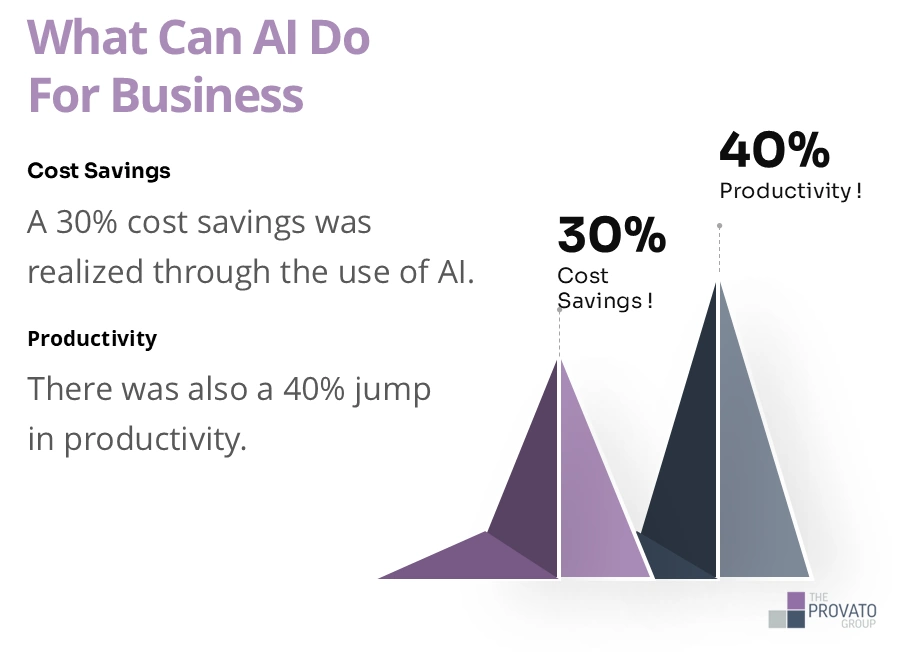
Businesses use AI to deliver measurable value across multiple areas of an organization. Recent studies demonstrate significant returns. In the 2024 study ‘The Benefits of AI and Automated Tasks On the Growth of Businesses’ by Doruk Efe Er it was found that when AI was used in accounting, it produced a 30% cost savings and a 40% boost in productivity. This was further supported by another 2024 study ”Creating AI business value through BPM capabilities’ by Aleš Zebec, M. Stemberger that found AI adoption improves decision making, process performance, automation, learning, and innovation.
Imagine this scenario.
Your business has a three person accounting team. Friday’s are lost in a sea of reconciliations without AI. But with AI, invoices are classified and exceptions routed automatically. Now your Fridays are forecast reviews, and the CFO is asking better questions.
Knowing these capabilities, it’s important to consider whether the cost of artificial intelligence technologies makes sense for your business.
How Much Does AI Cost Businesses?
The cost to integrate a new AI feature can range from $10,000 to $500,000+ depending on factors such as data acquisition, computing infrastructure, talent, model development, integration, and regulatory compliance needs.
| Project Type | Typical Cost Range (USD) | Description / Examples |
|---|---|---|
| Basic AI Features | $10,000 – $50,000 | Chatbots, rule-based systems, simple automation with pre-built models and APIs |
| Mid-Complexity AI Solutions | $50,000 – $250,000 | Custom ML models, predictive analytics, basic generative AI (MVP level) |
| Advanced / Enterprise AI | $150,000 – $1,000,000+ | Large-scale generative AI, multi-modal AI, full integration into critical systems |
| Custom Generative AI Features | $50,000 – $500,000+ | Text/image/code generation, fine-tuned domain-specific AI models |
It’s important to keep in mind that most clients don’t jump right into a six figure project. What we normally see are projects that start with $25k pilot programs, improving a single workflow to prove the savings. Only after the ROI is established do they begin to graduate into the larger integration projects.
While cost is an important factor, businesses must also understand the potential drawbacks of AI adoption.
What Are The Risks of AI in Business?
The disadvantages of AI in business include the costs of implementation and integration, data and privacy risks, ethical concerns around bias and transparency, job displacement, and a lack of human touch or consideration. Our team helps navigate these challenges by incorporating clear governance frameworks into projects, promoting ongoing risk management, tackling technical and data issues that may arise, and managing the change and final integration of the solution.
Keep in mind, most risks have simple answers. Take a case were a retailer rushed a recommendation engine model. The listed items appeared in carts, but there was no clear understanding on why. So we paused, added human review and some basic guardrails that their team could use to provide clear explanations and defend.
While these challenges do exist, it can be helpful to see how other businesses are using AI to create practical business value.
AI Security in Business: What You Need to Know
Security is a critical part of adopting artificial intelligence in business. AI security are the practices and principles that protect AI systems and the unique attack surfaces they introduce against threats or misuse by malicious actors to minimize risks associated with their use. AI security is a growing requirement for organizations. These systems and models are being integrated into critical business infrastructure at a rapid pace. If systems are attacked and successfully exploited they can leak private and proprietary business data. Attackers can bias AI models to produce outcomes favorable to their goals. That can lead to massive financial loss from fraud, increased costs, and in some cases legal repercussions.
How Are Businesses Using AI?
Businesses use AI to automate repetitive HR workflows, sales enablement, process optimization, data analysis for decision making, and logistics to eliminate bottlenecks and improve accuracy across the entire organization.
It’s important to keep in mind that AI is a value add for your teams. It’s not there to replace them. That means AI can be used in very specific ways depending on what industry you are in from predictive maintenance, to quality assurance, and even personalized patient diagnostics in healthcare.
Sales: Our team has built an entire recommendation engine to aid with sales. That system uses a sophisticated machine learning matrix to deliver customer insights, buying patterns, and laser-accurate product suggestions.
Manufacturers: Imagine not having to be surprised by equipment failures. We’ve built predictive maintenance systems that let you schedule downtime without heroics and chaos involved.
Financial Services: Teams stop chasing every alert, trying to catch up on the details. Instead the AI system tells them why the transaction looks suspicious, and by having that reason the team can address it immediately.
Those are just a few examples, but really the applications of AI in business are unlimited.
How Does Machine Learning and AI Help Businesses?
Machine learning (ML) and AI help businesses by working together through a layered and integrated approach. ML is trained on business data to discover hidden patterns, forecast outcomes, and classify information while AI acts as the decision layer which uses the ML predictions for continuous, real-time decision making, workflow coordination, and iterative data feedback.
Key Steps, Benefits, and Outcomes of ML and AI Working Together
| Step | ML + AI Roles | Business Benefit | Outcome |
|---|---|---|---|
| Data Integration |
ML: Gathers & preprocesses data AI: Ensures data flows across platforms |
Seamless Integrations | Unified dashboards linking teams and systems |
| Model Development |
ML: Trains on patterns from data AI: Selects/combines models as needed |
Enhanced Decision-Making | Real-time market trend forecasting |
| Application Embedding |
ML: Provides predictive outputs AI: Embeds predictions into workflows/apps |
Adaptive Automation | Supply-chain orders triggered autonomously |
| Continuous Improvement |
ML: Retrains with new incoming data AI: Monitors & optimizes system rules |
Continuous Optimization | Revenue growth via ML-driven pricing updates |
| — | — | Better Customer Experience | Personalized chatbot & product suggestions |
| — | — | Human Value Uplift | Staff shift from admin to innovation |
| — | — | Error Reduction | Lower fraud and process mistakes |
| — | — | Scalability & Agility | Fast deployment of new campaigns and services |
Our approach to AI development focuses on creating custom machine learning models that are designed to integrate with your existing systems and business processes, leveraging AI to create finished applications that learn, adapt, and evolve over time. We’ve found that integrated AI is far more effective at transforming business operations that standalone, siloed components.
How To Identify AI Opportunities in Business
Businesses can identify AI opportunities by looking closely at their existing processes to find inefficiency, starting with data-driven tasks, customer service, inventory management, and HR duties such as scheduling. After completing a process analysis, use cases should be validated and prioritized based on measurable outcomes balanced against your organization’s readiness to integrate AI systems into those operations.
The 2020 paper ‘The strategic use of artificial intelligence in the digital era: Systematic literature review and future research directions’ by Aline de Fátima Soares Borges et al suggests evaluating four key sources of new business opportunities that can be used to create business value with AI.
- Decision Support: AI can provide an opportunity for deeper insights and analytics to help teams make better, more informed decisions.
- Customer and Employee Engagement: AI can be used to enhance customer experiences through personalization and to improve satisfaction.
- Automation: AI can automate various tasks, processes, and workflows that are repetitive, freeing up human talent for tasks that create more value.
- New Products and Services: AI opens up the opportunity for the creation of innovative products and services, opening up new markets and revenue streams.
This framework can be used for integrating AI into business strategy, bringing attention to potential benefits, challenges, and even critical business problems.

How To Apply AI To Address Critical Business Problems
Applying AI to address critical business problems requires a framework that allows you to identify specific challenges, map them directly to AI-driven solutions that deliver measurable impact, select machine learning or artificial intelligence methodologies that fulfill those needs, and use metrics that demonstrate change.
What Are Real Examples of AI Addressing Business Problems?
| Business Problem | AI Application | Impact |
|---|---|---|
| Data Overload | ML for insight extraction | Improved growth, product targeting |
| Customer Support | NLP chatbots for inquiries | Faster resolutions, satisfaction boost |
| Supply Chain Disruption | Predictive analytics | Stock prediction, cost savings |
| Fraud | ML anomaly detection | Reduced losses, compliance |
| Talent Recruitment | AI-driven resume sorting | Faster hires, better matches |
| Dynamic Pricing | ML-based pricing models | Increased margin, competitiveness |
| Workflow Automation | RPA for repetitive tasks | Efficiency, cost reduction |
Once you understand where you need to apply an AI solution, the next step is to develop an implementation strategy.
How To Implement AI in Business
To implement AI in business organizations must prioritize factors that align with their overall strategy, have clear value creation, earn buy-in from stakeholders, address employee concerns, prioritize data governance and ethics, and build internal competencies.
Research backs just how important it is to provide employees a route to upskill in their careers. The 2021 paper ‘Artificial Intelligence and Business Strategy towards Digital Transformation: A Research Agenda’ by F. Kitsios, Maria Kamariotou found that the main challenges to creating business value with AI are all rooted in practical implementation and the lack of expertise in its usage. Specifically, knowledge management and support systems were critical for sustainable AI integration success.
How To Prepare Your Business for AI
Preparing a business for AI requires that an organization has the right strategic, cultural, and technical environment. More than just selecting tools, successful preparation requires a laser focus on data quality, skills development, governance, and fostering a business culture that values innovation.
The 2020 paper ‘Implementation of Artificial Intelligence (AI): A Roadmap for Business Model Innovation’ by W. Reim et al. laid the groundwork for a four step roadmap businesses should follow.
- Assess AI and organizational capabilities.
- Review and adapt current business models.
- Develop new competencies and infrastructure.
- Gain organizational acceptance and support.
Once that groundwork has been laid, you can move on towards integration.
How To Integrate AI Into Business Processes
Integrating AI into business processes requires the thorough mapping of existing workflows, identifying pain points that can be used for integration, and developing solutions that improve rather than disrupt established operations. Initial AI integration tasks normally revolve around repetitive HR workflows, sales enablement, and logistics to eliminate bottlenecks and improve accuracy across the entire organization.
Our integration approach for clients revolves around building tools that integrate somewhat seamlessly within their existing business and digital ecosystem to improve current processes without a major overhaul.
How Can I Use AI To Automate Business Processes
AI can be used to automate a large variety of both routine and complex business processes with new levels of intelligence. Research has shown there are some common use cases that apply to most businesses and deliver measurable results.
- Invoice and Email Automation – Leveraging classification, natural language processing (NLP), and robotic process automation ( RPA) to improve speed, accuracy, and reduce costs. [Ribeiro, J., Lima, R., Eckhardt, T., & Paiva, S. (2020). Robotic Process Automation and Artificial Intelligence in Industry 4.0]
- Customer Service (Chatbots) – NLP and deep learning are used to provide scalable, 24/7 support. [Mangal, A. (2024). The Role of RPA and AI in Automating Business Processes in Large Corporations.]
- Supply Chain Optimization – Predictive analytics and machine learning are used to improve resource utilization and drive operational efficiency. [Ribeiro, J., Lima, R., Eckhardt, T., & Paiva, S. (2020). Robotic Process Automation and Artificial Intelligence in Industry 4.0]
- Document Processing – Optical character recognition (OCR), NLP, and RPA are key drivers in reducing manual human effort. [Shidaganti, G., Salil, S., Anand, P., & Jadhav, V. (2021). Robotic Process Automation with AI and OCR to Improve Business Process: Review.]
- Decision Support – Bayesian networks and clustering allow for superior strategic planning, and data-driven decision making. [Gomes, P., Verçosa, L., Melo, F., Silva, V., Filho, C., & Bezerra, B. (2022). Artificial Intelligence-Based Methods for Business Processes: A Systematic Literature Review.]
It’s important to keep in mind that process automation with AI comes with unique challenges that businesses must be prepared to address.
What Are the Key Challenges Businesses Face When Integrating AI?
Challenges businesses face when integrating AI go far beyond technical issues, often focused on leadership, workforce adaptation, legacy integration, and realizing business value. Due to their strategic impact and severity, these organizational hurdles often require direct attention from CEOs to address. Research has shown how aware business leadership already is of these issues.
According to a 2025 study by Cisco, 4 out of 5 CEOs recognize AI’s potential but worry about weaknesses created by their gaps in understanding. The same study found that CEOs must maintain a compelling long-term vision delivered through clear communication that demonstrates how business objectives are aligned with AI adoption, with 96% relying on trusted partners.
The 2024 paper ‘Leveraging artificial intelligence for enhanced supply chain optimization’ by Louis, N., & E. found that while AI integration has tangible benefits for businesses, business leadership sees finding skilled personnel is a critical challenge in driving workforce adaptation.
Legacy systems integration has also risen to the top of the list concerns business leadership has when integrating AI. In the 2021 study ‘Artificial intelligence in E-commerce fulfillment: A case study of resource orchestration at Alibaba’s Smart Warehouse’ by Dan Zhang et al demonstrated how modern AI integration requires significant orchestration with established business and legacy systems.
While many CEOs may find demonstrating AI’s business value challenging in the broader sense, business intelligence applications are one area where’s its value is quickly and easily understood.
How AI Is Transforming Business Intelligence (BI)
AI is not only making business intelligence faster, but also more comprehensive, timely, and strategic than possible ever before. In fact, AI-powered business intelligence is becoming known as “NextGen BI” as reporting dashboards move away from static dashboards to more dynamic and automated action-focused panels which offer deeper interpretation that allows for more precise anticipation rather than reaction to market changes.
AI’s impact on the business intelligence responsible for mergers and acquisitions is profound, allowing organizations to quickly summarize the financial health, market position, and any recent news on potential targets to accelerate risk analysis and due diligence. A very recent 2025 study titled ‘Artificial Intelligence on Merger and Acquisition Processes: Observation from The Target Identification and Due Diligence Perspectiver’ by Rashid, M. showed that by processing large volumes of data quickly, AI was able to help identify potential acquisitions by uncovering hidden value, risks, and real-time insights that would be impossible for human teams to find otherwise. The same AI systems could then carry out faster and more accurate due diligence, ultimately resulting in better business outcomes.
While AI has been responsible for so much transformation, it’s also important to consider how it will replace traditional approaches to business intelligence.
Will AI Replace Business Intelligence?
No, AI will not replace business intelligence. While artificial intelligence and machine learning systems excel at rapid data processing, it doesn’t have the ability to interpret findings within a broader context for the market or business, or make nuanced decisions about how those findings align with company objectives.
AI’s role in BI is transformative, not a replacement. It serves as an enabler and integrator within existing BI systems with the purpose of making data analysis faster, more accurate, and more accessible to non-technical users. Human expertise will remain an essential component for interpreting complex results, addressing ethical or contextual considerations.
Research has backed that AI performs the best on the ‘Top Layer’ of BI systems. The 2020 paper ‘AI business model: an integrative business approach’ by Shruti Mishra et al was able to show that AI and machine learning work together at a high level in existing digital systems to fuel business opportunities over the course of phases.
How Is Business Intelligence Different From Artificial Intelligence?
| Aspect | Business Intelligence (BI) | Artificial Intelligence (AI) |
|---|---|---|
| Purpose | Provides insights from historical and current data to aid business decisions | Enables machines to simulate human intelligence, learn, and make autonomous decisions |
| Techniques | Data warehousing, reporting, dashboards, OLAP, data mining | Machine learning, deep learning, natural language processing, robotics |
| Output | Descriptive and diagnostic analytics (what happened, why) | Predictive and prescriptive analytics (what will happen, what to do), automation |
| Human Involvement | Relies on human interpretation and decision-making | Can automate decision-making and adapt to new data with minimal human input |
| Scope | Primarily business-focused, structured data | Broader applications (business, robotics, healthcare, etc.), structured/unstructured data |
These differences and how they are integrated into existing systems will impact how businesses approach analytics overall.
How Does AI Affect Business Analytics?
AI is revolutionizing business analytics by transforming them from being purely descriptive of the past to forward-looking and action oriented across the entire organization. Self-service AI tools combine NLP and intuitive interfaces to give less technical users the ability to explore data, ask questions, and generate visualizations with personalized, conversational queries.
Research has shown that AI systems help drive a data-driven culture deeper into business units across an entire organization, but brings additional risks in doing so. In the 2021 paper ‘Understanding dark side of artificial intelligence (AI) integrated business analytics: assessing firms’ operational inefficiency and competitiveness’ by Nripendra P. Rana et al it was clearly demonstrated that AI-BA opacity, caused by lack of governance, poor data quality, and inefficient training of key employees, leads to suboptimal business decisions and higher perceived risk, resulting in operational inefficiency and competitive disadvantage.
Therefore, when integrating AI into your business analytics it’s important to be sure that you have a firm grasp of your broader business data management.
How Can I Use AI for My Business Data?
You can use AI to maximize the value you get out of structured business data, particularly through data cleaning, unification, and enrichment, along with analytics and predictive insights. Additionally, NLP allows you to extract key topics and sentiment from unstructured business data as well such as reviews, support tickets, and industry news.
Research has shown how manufacturers in particular benefit from implementing AI with their business data. The 2023 paper ‘Artificial intelligence enabling circular business model innovation in digital servitization: Conceptualizing dynamic capabilities, AI capacities, business models and effects’ by D. Sjödin et al demonstrated that manufacturers were able to improve resource utilization and decision making through circular business model innovation after AI was used to analyze historical business data, and then applying what was learned to future business decisions.
That type of approach to data intelligence demonstrates how AI and data work together to add tangible business value.
How Artificial Intelligence and Data Add Value to Businesses
Artificial intelligence and data add value to businesses by evolving strategy, delivering first-mover innovation, and leveraging new data-driven capabilities to create a competitive advantage in their market. The value creation mechanisms that most frequently benefit from AI are new business models, strategic alignment and transformation initiatives, embedding AI into existing business model architecture to capture substantial value appropriation, and continuous business product innovation.
Studies have shown us that one of the biggest hurdles remains the understanding of what value to expect from AI integration. The 2021 paper ‘Artificial Intelligence and Business Value: a Literature Review’ by Ida Merete Enholm et al that while AI technologies offer business value advantages to organizations, they often lack a coherent understanding of how and what type of value is expected.
One source of value that you can expect across all industries is going to be the support of business decision making.
How Artificial Intelligence Helps You Make Better Business Decisions
Artificial intelligence helps businesses make decisions that are not only faster, but smarter, responsive, and strategically aligned to create a level of business agility that would have been previously impossible with traditional analytics or human expertise. When AI is integrated into day to day business workflows it drives foresight and intelligence that raises both the quality and impact of decisions.
Research backs this. In the 2021 paper ‘AI based decision making: combining strategies to improve operational performance’ by Abdulrahman Al-Surmi et al it was shown that industries like manufacturing were able to improve their operational performance and decision accuracy by using an integrated AI-based decision making framework.
In a larger sense, it’s important to consider that improving decisions is also a driver in broader business growth as well.
How To Use AI To Grow Your Business
AI can be used to grow your business by generating new value, accelerating innovation, and implementing an evidence-based strategy to outpace your competition by letting your business data guide critical expansion moves. Machine learning and artificial intelligence systems continually optimize your organization’s growth levers by creating differentiated offerings, testing growth strategies, and fueling continuous market innovation without human intervention, or being slowed by costly missteps.
AI-driven business growth is well documented and proven by recent research. The 2024 paper ‘Artificial intelligence, firm growth, and product innovation’ by T. Babina et al draw the conclusion that firms who invested in AI experienced higher sales, employment, and market valuations primarily through increased product innovation. The 2020 paper ‘Influence of artificial intelligence (AI) on firm performance: the business value of AI-based transformation projects’ by Serge-Lopez Wamba-Taguimdje et al found that AI based projects improved the business value of the organization’s transformed projects by improving both the organizational and process performance of that project.
In our experience, businesses that want to grow by using AI should focus not only on processes and data, but new business development as well.
How To Use AI for Business Development
AI is best used for business development when it transforms it from reactive to proactive, data-driven opportunity creation through scalable and target growth moves. When considering AI based business development, it’s important to think about more than just opportunity identification or lead generation.
Your organization can use AI to help tackle territory planning and market entry, letting your business development leaders expend resources strictly where there is the greatest future opportunity. You can also secure first-mover advantages by launching new initiatives and solutions before the market has time to catch up.
Of course, AI’s impact on business development extends to marketing strategy particularly well.
How Can AI Support Marketing Strategies in Business?
Artificial intelligence can support complex, nuanced marketing strategies that go far beyond planning and discovery. here the focus of AI is to help reach and convert audiences.
- Social Listening and Brand Intelligence: AI-powered social listening tools provide proactive intelligence that can track thousands of online conversations simultaneously, giving brands an accurate gauge on sentiment, identifying reputational risks, and discovering new engagement avenues to expose entirely new growth channels.
- Dynamic Market and Customer Adaptation: AI systems are able to map entire customer journeys across channels, classifying critical decision points, and evolve your team’s engagement to user intent, dramatically improving conversion impact and engagement.
- Resource and Customer Classification: Machine learning systems can use historical data to create classifications based on supervised training that guides marketers to the best channels and content types to engage specific buyer personas with.
Of course, AI applications used for marketing cross over to user experience quite easily.
How Can AI Improve Customer Experience in Business?
AI can improve customer experience (CX) in business by deepening relationships, providing helpful support, and creating a sense of brand loyalty. here the focus is to serve and retain customers.
AI Strategies for CX Improvement
| Strategy | Area of Impact | Example Application |
|---|---|---|
| Sentiment & Empathy Analysis | Emotional connection, loyalty | Prioritized, tailored support responses |
| Journey Management | Multichannel cohesion | Seamless transitions between service channels |
| Proactive Outreach | Retention, preventive service | Maintenance reminders, targeted offers |
| Intelligent Agent Enablement | Efficiency, support quality | Real-time call coaching, onboarding help |
| Social Listening/Call Routing | Engagement, optimal assistance | NLP routes inquiries based on context |
| Voice Authentication | Security, convenience | Biometric access to sensitive data |
| Survey/Review Analytics | Continuous improvement | NLP harvesting feedback themes |
By putting these technologies to work in your customer experience initiatives, you will better understand your customers and their preferences.
How Can AI Help Businesses Better Understand Their Customers?
AI can help businesses create an evidence based understanding of their customers that is dynamic and continuously adapting to evolving desires. Machine learning systems can be trained to reveal hidden behavioral patterns, segment audiences with classification, and analyze changing sentiment about your brand across all major channels.
Research heavily supports the effectiveness of AI driving customer insight. The 2024 paper ‘Impact of Artificial Intelligence in Customer Journey’ by Pendyala, M., & Lakkamraju, V. found that AI-powered systems give businesses the data they need to understand customer behaviors, preferences, and sentiment in actionable ways that then let those organizations dramatically improve satisfaction and loyalty in ways that feel natural and not forced.
The 2020 paper ‘From data to action: How marketers can leverage AI’ by Colin Campbell et al found that AI gave businesses the tools they needed to provide additional levels of service and support during interactions with customers, as well as aided with the identification of optimal promotions that felt helpful, not pushy.
These same customer insights are especially valuable when integrated into the business planning process.
How To Use AI for Business Planning
| Strategy Type | Key Actions / Focus Areas | Business Benefit | Implementation Considerations |
|---|---|---|---|
| Dynamic Planning | Reinforcement learning, real-time feedback, resource optimization | Agility in adapting to market changes; better resource allocation | Requires real-time data streams, robust feedback loops, and careful monitoring to avoid bias in decision-making |
| Business Model Innovation | Data pipelines, algorithm development, ecosystem integration | Creation of new revenue streams; stronger digital ecosystems | Needs collaboration with partners, strong API ecosystems, and investment in data engineering capabilities |
| AI-First Model Design | New value propositions, data-centric roles, platform models | Competitive differentiation by embedding AI at the core of the business plan | Requires cultural shift, executive sponsorship, and alignment between data teams and business leadership |
| Organizational Readiness | AI talent, data governance, culture of innovation | Workforce capable of scaling AI initiatives; improved compliance and trust | Ongoing investment in training, ethical frameworks, and balancing innovation with risk management |
AI provides significant value in other areas of planning as well, such as financial management and budgeting.
Should You Use AI for Business Budgeting?
Yes, you should consider using AI for business budgeted. it strengthens financial management by offering adaptive and highly accurate projects in business environments with many moving variables or unpredictable trends.
- Pattern Recognition: Identifies anomalous spending, unusual resource allocation, and unexpected costs.
- Adaptive Forecasting: Generates flexible projections in rapidly changing market conditions.
- Applicability: Supports both enterprises and small businesses.
These benefits apply to both large enterprises and small businesses alike.
How AI Can Help Small Businesses
Small businesses are often in a great position to begin implementing AI into their operations, and will benefit from some unique advantages that larger businesses may struggle to realize as easily.
- Hyper-Localized Personalization: Small businesses can use hyper-local purchasing pattern data to deliver finely-tuned, relevant services and offerings. Unlike larger organizations, small businesses have the flexibility to create AI powered experiences that are laser focused on their immediate customer base.
- Owner Informed Experimentation: By leveraging AI as an advisor, small business owners can run rapid fire experiments on new products, pricing structures, and messaging with “Try and pivot” cycles at a speed and granularity large corporations can’t match.
- Customer Co-Creation: Small businesses can engage their customers in collaborative and creative ways by using AI to let them generate product designs, vote on new offerings, and personalize their experiences in real time.
- Niche Branding and Content Generation: Small businesses can use generative AI to rapidly produce brand assets (images, videos, or promotional content) that would be too costly for larger organizations to develop at scale.
How Can Generative AI Be Used in Business
Generative AI is used in business to create entirely new business models, products, and services that were previously impossible or impractical. From content generation, to simulating complex scenarios, and automating creative or regulatory tasks, generative AI is driving innovation across industries with ongoing research focused on expanding its capabilities.
Research backs generative AI’s effectiveness. The 2023 paper ‘The GenAI is out of the bottle: generative artificial intelligence from a business model innovation perspective’ by Dominik K. Kanbach et al and the 2023 paper ‘From fiction to fact: the growing role of generative AI in business and finance’ by Boyang Chen both demonstrated how generative AI is being used to improve accessibility, efficiency, reduce costs, and drive business model innovation for various industries such as software engineering, healthcare, and financial services.
Unique Generative AI Business Applications
| Use Case | Description |
|---|---|
| Automated Content Generation | Generative AI can produce high-quality marketing copy, product descriptions, reports, and multimedia content (images, audio, video) at scale, reducing reliance on manual creative processes and enabling rapid content personalization for different audiences. |
| Business Model Innovation | Companies are using generative AI to create entirely new products and services, such as AI-driven design tools, automated code generation platforms, and synthetic data creation for testing and training, fundamentally altering how value is delivered and captured. |
| Enhanced Requirements Engineering | In software development, generative AI automates the transformation of user requirements into user stories, acceptance criteria, and technical documentation, streamlining the requirements engineering process and improving communication between stakeholders. |
| Synthetic Data Generation | Generative AI models can create realistic synthetic datasets for training, testing, and validating business systems, especially where real data is scarce or privacy is a concern (e.g., healthcare, finance). |
| Scenario Simulation and Risk Analysis | Businesses use generative AI to simulate market scenarios, generate alternative business strategies, and model risk factors, supporting more robust decision-making in uncertain environments. |
| Automated Compliance and Design Optimization | In industries like construction, generative AI automates code compliance checking, optimizes building designs, and interprets complex regulatory documents, improving efficiency and reducing errors. |
| Workforce Training and Simulation | Generative AI powers realistic training simulations, enabling employees to practice skills in virtual environments tailored to specific business contexts. |
How Can Businesses Implement AI for Enhanced Security Measures
Businesses can implement AI for enhanced security measures by targeting advanced, low-level applications that go far deeper than typical cybersecurity use cases.
- Autonomous Defense with AI Agents: AI agents shift passive detection to proactive, aggressive defense by autonomously correlating diverse data types and investigating threats, immediately responding to attacks at a device or network level.
- Offensive AI Security Testing: AI powered testing systems can simulate sophisticated cyberattacks by running ongoing penetration tests and red-team scenarios at scale. These systems can probe for new vulnerabilities with adaptive attack strategies when new features, integrations, or configurations are deployed to find weaknesses before malicious actors do.
- AI-Augmented Vulnerability Prioritization: While traditional methods of relying on CVSS scores is effective, AI vulnerability management systems evaluate real exploitability, attack vectors, paths of exposure, and business context with real time threat intelligence.
- Securing AI Stacks and Shadow Infrastructure: AI can help secure the growing world of shadow IT such as unauthorized models, extensions, packages, and services accessed by users outside of officially vetted and approved channels.
- AI-Based Behavioral Analytics for Insider Threats: AI continuously establishes behavior profiles for users, endpoints, and service accounts, enabling the detection of subtle anomalies that human reviewers may overlook. These insights strengthen defenses against insider threats and form the foundation for detecting complex fraud risks.
These granular, adaptive security systems help identify and target a wide range of vulnerabilities, not the least of which being business fraud.
How AI Can Detect Business Fraud
AI can detect business fraud with deep, context aware approaches to achieve real time defense by using deep reasoning, behavioral analysis, and continuous learning which are all methods far beyond traditional anomaly detection.
Contact Aware Fraud Defense With AI Agents: When AI agents are focused on business fraud detection they process and understand user intent, automatically execute countermeasures, and optimize risk scoring based on evolving attack vectors. The agents are able to respond to even high sophisticated “slow burn” fraud methodologies that are purpose built to evade static detection rules.
Deep Behavior Biometrics and Micro Pattern Analysis: Building on this behavioral foundation, fraud detection leverages more granular techniques such as behavioral biometrics and micro-pattern analysis such as tracking keystroke dynamics, geolocation shifts, and device hopping. These ultra-specific signals allow AI to uncover fraud attempts hidden within otherwise legitimate workflows.
Dynamic Data Correlation: AI systems correlate cross-system patterns to reveal multi-step or coordinated fraud attempts that static systems will miss using disparate datasets including structured finance data, user communication logs, and even vendor behavior metrics.
Of course, fraud detection is only one of the many benefits AI offers businesses.
What Are the Benefits of AI in Business
AI’s business benefits are realized through transform learning, collaboration, strategy, innovation, and sustainability, enabling organizations to adapt and achieve optimal business outcomes even in rapidly changing environments.
| Mechanism | How AI Delivers Value | Supporting Research |
|---|---|---|
| Organizational Learning & Process Innovation | Analyzes data to adapt processes and foster innovation | Enholm, I., Papagiannidis, E., Mikalef, P., & Krogstie, J. (2021). Artificial Intelligence and Business Value: a Literature Review. |
| Human-AI Collaboration & Job Design | Augments human roles, enabling creative and strategic work | Bankins, S., Ocampo, A., Marrone, M., Restubog, S., & Woo, S. (2023). A multilevel review of artificial intelligence in organizations: Implications for organizational behavior research and practice. |
| Strategic Decision-Making & Business Model Transformation | Synthesizes information for scenario planning and rapid pivots | Wamba-Taguimdje, S., Wamba, S., Kamdjoug, J., & Wanko, C. (2020). Influence of artificial intelligence (AI) on firm performance: the business value of AI-based transformation projects. |
| Product & Service Innovation | Accelerates ideation, testing, and optimization of new offerings | Cooper, R. (2024). The AI transformation of product innovation. Industrial Marketing Management. |
| Integration with Emerging Technologies | Combines with blockchain for new governance and business models | Kumar, S, Lim, W., Sivarajah, U., & Kaur, J. (2022). Artificial Intelligence and Blockchain Integration in Business: Trends from a Bibliometric-Content Analysis. |
| Sustainable Business Practices | Optimizes resources and supports environmental strategies | Goralski, M., & Tan, T. (2020). Artificial intelligence and sustainable development. |
| Organizational Creativity | Provides tools for ideation and experimentation across business functions | Mikalef, P., & Gupta, M. (2021). Artificial intelligence capability: Conceptualization, measurement calibration, and empirical study on its impact on organizational creativity and firm performance. |
In our experience, some of the biggest business benefits from AI are realized when it’s integrated with existing business software.
Can Agentic AI Systems Be Integrated With Existing Business Software?
Yes, agentic AI systems can be integrated with existing business software by building a platform for dynamic, autonomous, and context-aware operations within established systems. Successful integration depends on architectural assessment, middleware, careful system design, and ongoing attention to interoperability and data governance. New protocols will need to be established to allow multi-agent workflows and maintain existing system stability.
It is very rare that agentic AI integration is plug and play, but organizations should avoid full system replacements, and instead lean on overlays, connectors, and orchestration frameworks specific to agentic architectures.
Can AI Agents Be Customized for Specific Business Needs?
Yes, AI agents can be highly customized to address specific business needs, taking advantage of domain expertise, real-time adaptability, and modular architectures for collaborative problem solving.
Cognitive skills modules are purpose-built inference modules for AI agents that are tailored to individual business domains to enable specialized decision making. This domain-specific reasoning is fine tuned for industry knowledge and workflows. These are proven systems with the 2025 paper ‘Agentic Systems: A Guide to Transforming Industries with Vertical AI Agents’ by Fouad Bousetouane demonstrating how well LLM agents in particular perform with inference capabilities to reason and draw conclusions based on.
Multi-agent collaboration combines the expertise of multiple specialized agents, each trained on different business functions or knowledge to solve problems by working together. The 2025 paper ‘AI Agents vs. Agentic AI: A Conceptual Taxonomy, Applications and Challenges’ by Ranjan Sapkota has shown how this approach improves both the breadth and depth of business solutions.
How Will AI Agents Change the Way Businesses Operate
Agentic AI will change the way businesses operate and drive business value by autonomously managing complex, cross-domain workflows, enabling real-time adaptation, and embedding deep domain expertise to deliver measurable improvements in cost, speed, accuracy, and strategic agility that traditional AI cannot match.
Unlike basic automation or analytics AI systems, agentic AI agents can reason, take initiative, adapt, and coordinate actions independently across business processes and workflows to shift operations to full independent, self-managing, goal-seeking systems.
About The Author
Brian McCracken has been solving complex technology challenges for nearly 25 years. Since joining The Provato Group in 2021 he has focused on helping businesses create web experiences that are both powerful and discoverable.
Brian’s quarter-century in development gives him a practical perspective on AI integration. He’s seen enough technology trends to know which ones deliver real value and which ones are just hype. His approach centers on building AI solutions that actually solve business problems while creating interfaces that users genuinely want to engage with.