
Improving Manufacturing Efficiency with Research-Proven Strategies
Manufacturing efficiency is the cornerstone of modern industrial success, enabling production firms to maximize profits and sustainability efforts while minimizing resource consumption. Drawing from decades of research and real-world case studies from institutions such as Massachusetts Institute of Technology (MIT), University of Washington, and Vienna University of Economics and Business (Wirtschaftsuniversität Wien), this guide details how industrial producers can achieve world-class efficiency levels of 85% or higher through strategic process optimization, energy management, and cutting-edge Industry 4.0 technologies.
You’ll discover proven methods to measure, diagnose, and improve your operations using data-driven approaches like Overall Equipment Effectiveness (OEE), Material Flow Cost Accounting, and custom software solutions. From Japanese companies saving billions through targeted efficiency improvements to European manufacturers reducing energy consumption by over 20%, these research-proven strategies offer a clear roadmap to transforming your production operations for improved efficiency, performance, and firm profitability.
Key Information Points:
Out of 1,007 manufacturing firms studied in 2021, only 29 were found to be truly efficient under variable returns to scale assumptions.
A manufacturing software implementation study showed defect rates dropping from 14.61% to 6.12%, and breakdown time from 2,502 to 1,161 minutes.
When production efficiency issues were addressed, one company saved 210 MWh of energy, 1.4 million m3 of compressed air, and €61,000 in annual costs.
A 2019 study of 137 manufacturers found that output could be increased by 30.12% without increasing input needs by addressing inefficienes.
Improving manufacturing efficiency allowed one company increased daily production by 31.95%, and decreased raw material waste by 29.6%.
What Is Manufacturing Efficiency?
Manufacturing efficiency is the systematic measurement and pursuit of producing goods at the lowest cost and highest potential profit. It is achieved by optimizing energy expenditure, material usage, machine utilization, and production management.
Why Is Manufacturing Efficiency Important?
Improving efficiency helps firms improve their economic performance with less potential impact from external factors as input requirements remain the same. Research has shown that manufacturing process optimization focused on efficiency is critical for achieving competitive industrial production, improving profitability, reducing environmental impact, and promoting resource sustainability.
The 2013 study ‘Exploring the relationship between efficiency and profitability’ by Keramidou, Ioanna, Angelos Mimis, Aikaterini Fotinopoulou, and Chrisanthos D. Tassis demonstrated that efficiency gains above 80% improved profitability in the short term for mall and medium sized firms. This is further supported by a joint 2015 study from Keimyung University, Sogang University, and Savannah State University demonstrated that improvements in manufacturing process efficiency lead to improved organizational performance.
Industrial manufacturing efficiency’s impact on pollution, atmospheric changes, and ecological consequences is an growing concern internationally. Manufacturing firms in the United States have particularly poor efficiency, with energy use being the most significant in terms of ecological impact. A 2013 study from the University of Central Florida revealed that 90% of US manufacturing sectors are inefficient and require significant improvements in their life cycle performance. A 2019 study from the Università Politecnica delle Marche and Università degli Studi della Tuscia shown that improving manufacturing efficiency was a key success factor for sustainable production, reducing energy demand and greenhouse gas emissions.


How Is Manufacturing Efficiency Different from Cycle Efficiency?
The main difference between manufacturing efficiency and manufacturing cycle efficiency (MCE) lies in what they measure: manufacturing efficiency evaluates how well resources like labor and equipment are used compared to standard expectations, while MCE specifically focuses on the ratio of value-added time to total production time. Value-added time includes only activities that directly transform the product in ways the customer values.
How Is Manufacturing Efficiency Different from Productivity?
The main difference between manufacturing efficiency and productivity is that manufacturing efficiency focuses on optimizing operations, processes, and resource use, while productivity measures the overall output relative to the inputs used. Higher manufacturing efficiency typically leads to higher productivity, as improved efficiency often results in increased output for the same or fewer resources.
How is Manufacturing Efficiency Measured?
The most basic formula to calculate manufacturing efficiency is by dividing the standard output by the actual output, then multiplying the result by 100. Standard output (actual output/industry standard output) is the ideal or expected output under normal circumstances. Actual output (total input/total output) is the actual quantity of goods produced during a specific period. If your actual output matches your standard output, your efficiency is 100%.


What is A Good Manufacturing Efficiency Ratio?
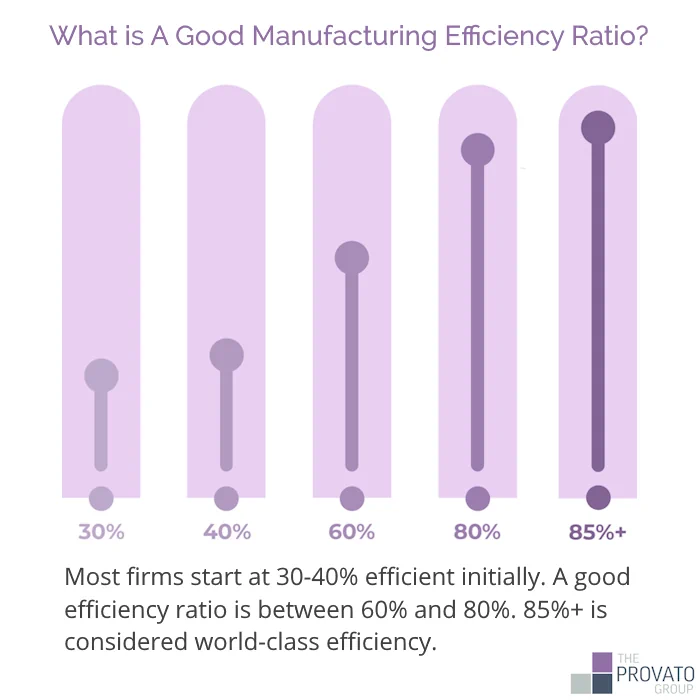
A good ratio for manufacturing efficiency is typically between 60% and 80%. 40% is a common ratio for firms that are just starting to evaluate their efficiency, while 85%+ is considered to be world-class performance and difficult to achieve.
Smaller and medium sized firms that are just beginning to measure their efficiency often find that they are only 30-40% efficient, and due to their size don’t yet have the means to readily control input. Fortunately, research has proven that it is easier for production firms to improve output via efficiency optimizations than it is to control input. A 2019 study by the Symbiosis Institute of Operations Management (Constituent of Symbiosis International Deemed University), Nashik studied 137 machinery manufacturers from 2005-2010 and found that output could be increased 30.12% without increasing input needs.

What Other Methods Are Used To Measure Manufacturing Efficiency?
More comprehensive methods of measuring efficiency include:
- Overall Equipment Effectiveness (OEE): OEE considers availability, performance, and quality to measure the efficiency and effectiveness of equipment in a manufacturing process. A 2008 literature research paper by study by Peter Muchiri and Liliane Pintelon established OEE as a foundational tool for manufacturing process performance measurement, noting that its success has lead to the creation of similar tools for measuring equipment effectiveness.
- Data Envelopment Analysis (DEA): DEA is used to measure and set static performance targets in manufacturing systems by identifying performance peer groups and guiding improvement efforts. A 2011 study from Jain, Triantis, and Liu demonstrated how effective DEA is for tracking efficiency fluctuations over time, and in one example from the research they increased production by 4.67% to become efficient.
- Dynamic Efficiency Measures: A 2010 study by Chien-Ming Chen and Jan van Dalen corrected some shortcomings of DEA by accounting for changes in a production environment, resulting in what is known as dynamic efficiency measures. Dynamic efficiency measures take into account the temporal interdependencies and adjustments that occur in production environments, providing a more accurate and comprehensive evaluation of efficiency than static measures.
- Resource Value Mapping (RVM): RVM is useful for determining resource efficiency, identifying waste, and non-value-added consumptions. A 2019 study by the Department of Industrial Engineering and Mathematical Sciences, Università Politecnica delle Marche and Department of Economics, Engineering, Society and Business Organization, Università degli Studi della Tuscia revealed less than 20% of consumed resources were actually creating value. The action plans were projected to save 210 MWh of energy per year, over 1.4 million m3 of compressed air per year, €61,000 in annual costs, and 105 tons of CO2 equivalent emissions per year.
- Value Stream Mapping (VSM): VSM is a lean tool used to analyze material and information flow to identify areas for improvement in manufacturing processes. A 2008 study from Sri Jayachamarajendra College of Engineering reduced machine setup time by 400 minutes per month, saved 200 minutes per month of probe measurement, and eliminated 1080 minutes per month of wasted cycle time for a medium-scale manufacturer.
The method used to measure manufacturing efficiency depends heavily on the type of processes in place, as different production methods (e.g., discrete, batch, or continuous) require tailored metrics. To effectively evaluate efficiency, industry professionals typically focus on several key metrics that provide insights across different aspects of the production process.
What Metrics Are Commonly Used When Measuring Efficiency?
The most common metric categories are production, quality, general efficiency, cost, time-based, safety and environmental, maintenance, and continuous improvement.
Production metrics focus on output, equipment usage, and production efficiency. They help track bottlenecks, schedule and plan production capacity, and optimize machine utilization.
Quality metrics are used to predict defects, consistency, and drive customer satisfaction by maintaining product standards. They are the main drivers of continuous improvement efforts.
Efficiency metrics are used to identify underutilized resources and unnecessary expenses through the optimization of staffing levels, energy costs, and maintenance schedules.
Cost metrics control budgets and product pricing by tracking expenses, value generation, and inventory. They are critical for financial planning and profitability analysis.
Time-based metrics evaluate production speed, delivery reliability, and setup or changeover efficiency to reduce lead times, eliminate bottlenecks, and meet commitments.
Safety and environmental metrics review workplace accidents, impact, and compliance to aid with risk management, and ensure regulatory adherence.
Maintenance metrics attempt to optimize schedules, while reducing unexpected downtime and repair costs by tracking equipment reliability and maintenance effectiveness.
Continuous improvement metrics aim to drive constant optimization, drive cultural change, and embrace innovation through manufacturing process improvement initiatives.
The analytical methods and metrics outlined offer a wealth of data on manufacturing efficiency. However, they often only provide a snapshot of current performance without greater context of your operation. The real challenge is in interpreting these metrics to recognize the common factors contributing to efficiency shortfalls, and developing targeted strategies for improvement.
What Are the Most Common Factors Affecting Manufacturing Efficiency?
Manufacturing efficiency is influenced by a combination of internal and external factors. Critical internal drivers include high-quality management, having in-house R&D teams, workforce skill and availability, equipment capability, and innovation adaption rate. External factors such as energy costs, material and supply chain factors, market demand and competition, regulatory compliance demands, and supportive economic policies play a significant role.
Research has shown that manufacturing efficiency is greatly impacted by a firm’s management being able to form strategic partnerships with foreign collaborators, and prioritize in-house research and development. The 2019 study from Singh, Ajay K. et al. “Estimating Factors Affecting Technical Efficiency in Indian Manufacturing Sector” evaluated 154 companies across 7 industries and found that firms without foreign collaboration demonstrated a statistically significant negative impact on efficiency. Less statistically significant negative factors included competition from foreign firms, poor or no relationships with public R&D institutions, and the absence of growth plans. The same study revealed that companies with more process innovations saw higher efficiencies, but having in-house R&D expertise had the highest association with improved efficiency (+0.0053for TE).


Energy efficiency has been shown to play a large role in overall manufacturing efficiency. A 2016 study from the University of Ljubljana and University of Washington examined 848 manufacturing firms over 7 years (2005-2011). The results demonstrated that energy efficiency investments for manufacturing lead to the chemical industry producing a 20.2% improvement in efficiency, the paper manufacturing sector showed a 17.2% improvement, and the total share of national energy consumption dropped from 35% to 24.6% for the entire industrial sector.
What Are The Common Signs of Manufacturing Efficiency Issues?
Efficiency issues are most easily spotted by monitoring key operational performance indicators. The following observational signs allow businesses to pinpoint areas where improvements are needed without getting lost in the minutiae of individual issues.
- Low Overall Equipment Effectiveness (OEE): A low OEE score indicates that equipment is not being utilized to its full potential due to issues with availability, performance, or quality.
- Excessive Energy Consumption: Higher-than-normal energy usage per unit of production can signal inefficient equipment or processes.
- Frequent Overtime: Reliance on overtime to meet production goals may suggest inefficiencies in scheduling or workflow.
- High Defect Rates: An increased number of products failing quality inspections points to problems in the manufacturing process.
- Underutilized Equipment: Machinery that is frequently idle or not scheduled effectively can lead to decreased productivity.
- Poor Inventory Turnover: Slow movement of finished goods inventory may indicate overproduction or lack of demand forecasting.
- High Maintenance Costs: Increasing expenses for equipment repairs may indicate aging machinery or poor maintenance practices.
- Customer Complaints: Frequent issues reported by customers may reflect underlying production problems.
How Do You Calculate the Cost of Efficiency Issues?
The most direct method of calculating the cost of efficiency issues is done by comparing the actual cost of production to the ideal cost of production at peak efficiency. The difference between them represents the cost of efficiency issues in a production system. A cost-benefit analysis should then be conducted to compare the potential cost of implementing improvements to assess the viability of corrective actions.


What Methods and Tools Can Help Diagnose Efficiency Issues?
Research has found that material flow cost accounting (MFCA), overall equipment effectiveness, and benchmarking with data envelopment assessment (DEA) are highly effective methods to use when attempting to diagnose efficiency issues.
Material Flow Cost Accounting (MFCA)
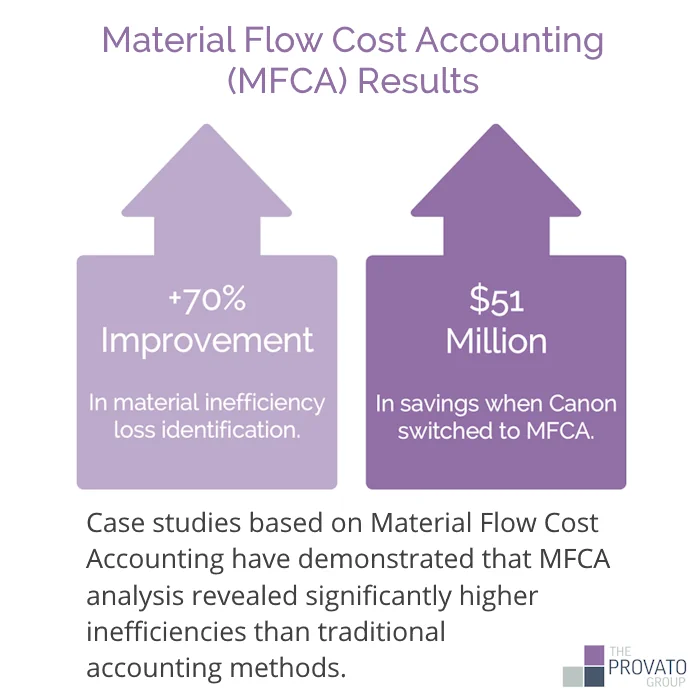
Material flow cost accounting (MFCA) is proven and frequently used method to diagnose inefficiencies, waste, and their associated costs in manufacturing processes. The 2017 study Yixuan Wang et al. “Potentials for Improvement of Resource Efficiency in Printed Circuit Board Manufacturing: A Case Study Based on Material Flow Cost Accounting” demonstrated that MFCA analysis revealed significantly higher inefficiencies than traditional accounting methods, accounting for over 70% of material costs in losses.
In the 2013 study Mario Schmidt et al. “Material Flow Cost Accounting as an Approach to Improve Resource Efficiency in Manufacturing Companies” Canon implemented MFCA at 17 plant sites globally between 2004-2012 and saved 5.1 billion Yen (approximately US $51 million). 15 Japanese companies implemented MFCA and found 20-30% of material losses (costs) on average, which was surprising as these companies had already implemented various material reduction measures. MFCA was standardized through ISO 14051 in 2011, and has since been implemented by over 300 companies in Japan based on the findings from this research.

Overall Equipment Effectiveness (OEE)
Overall equipment effectiveness (OEE) is a key performance metric that relies on availability, performance, and quality to determine the productivity of manufacturing equipment. It allows producers to quantify their how well their equipment is being utilized by assessing the actual output versus the full potential output. As stated by Peter Muchiri and Liliane Pintelon in their literary review “Performance measurement using overall equipment effectiveness (OEE): literature review and practical application discussion,” OEE has become a crucial performance measurement tool in the global competitive manufacturing environment. It was originally introduced as part of Total Productive Maintenance (TPM) in the 1980s by Nakajima, and has expanded beyond single equipment measurement to plant-wide metrics evaluation making it a more holistic tool for diagnosing efficiency issues.
Alternative OEE Methods Include:
- Overall Equipment Effectiveness of a Manufacturing Line (OEEML) has been introduced to assess the performance of entire production lines rather than individual machines, addressing the limitations of OEE in complex manufacturing environments as demonstrated in Braglia, M., Frosolini, M., & Zammori, F. (2008). ‘Overall equipment effectiveness of a manufacturing line (OEEML).’
- Stochastic OEE has been developed to account for the variability in manufacturing performance, providing a more dynamic and realistic measure of equipment effectiveness as shown in the results of the study Zammori, F., Braglia, M., & Frosolini, M. (2011). ‘Stochastic overall equipment effectiveness.’
- Overall Resource Effectiveness (ORE) extends OEE by including factors such as raw material usage and production environment, offering a more comprehensive performance metric as demonstrated in a 2015 study from the The University of Derby.


Benchmarking with Data Envelopment Assessment (DEA)
Benchmarking through the use of data envelopment assessment (DEA) is a robust method for diagnosing productive efficiency and identifying best operational practices within manufacturing systems. In a 2021 study out of the University of Dhaka collected data on 1007 manufacturing firms, and through the use of DEA found that only 29 of those firms were found to be efficient under the variable returns to scale assumption.
A 2006 study from the Wirtschaftsuniversität Wien (Vienna University of Economics and Business) and Massachusetts Institute of Technology (MIT) used DEA to benchmark 65 European and North American companies to diagnose supply chain efficiency issues, concluding that efficient supply chains lead to high financial performance.


How Do You Improve Manufacturing Efficiency?
Improving manufacturing efficiency involves a multifaceted approach that includes lean manufacturing techniques, insightful production planning, material utilization optimization, and continuous improvement methods.
Step 1: Process Optimization, Lean Manufacturing, & Bottleneck Identification
Bottleneck identification is a key part of efficiency improvement via lean manufacturing as it eliminates the weakest process in a system. A 2019 study from the Department of Management Science and Engineering in China found that identifying bottlenecks in manufacturing processes decreased the total cost of manufacturing by 19.73% with no negative effects.
Using process optimization to implement lean manufacturing techniques will significantly improve overall efficiency. A 2023 study from the Production and Industrial Engineering Department in Alexandria, Egypt used lean manufacturing principles to increase daily production by 31.95%, reduce cycle time by 19.82%, increase inspection and packaging overall efficiency by 10%, and decrease raw material waste by 29.6%.


Step 2: Software-Driven Algorithmization and Production Planning
Production planning through hierarchal and algorithmic approaches enable real-time adaptability to disruptions, multi-objective optimization balancing factors like cost, time, and sustainability, and integration with industry 4.0 tech such as artificial intelligence, IoT, and digital twins. When combined with custom manufacturing software, these approaches provide predictive capabilities for proactive decision-making, facilitate mass customization, and help mitigate risks against uncertainties.
Algorithmization of the planning process help improve production efficiency by standardizing the entire systems, and the generation of production plans that only produce what’s needed at a given time in order to reduce waste and improve cost control.
A 2023 study from the Department of Informatics and Computers, University of Ostrava saved at least 1 production line a week and increased total production capacity by 2% through the use of algorithmization of the planning process. The efficiency improvements were achieved without requiring major capital investments, making it a particularly valuable approach for manufacturers looking to optimize their existing operations.
Hierarchical planning is a layered approach that allows firms to break down their production decisions into distinct levels starting with big-picture strategic choices at the top, then working their way down to day-to-day operational details.
A 1996 study from the University of Maryland demonstrated that hierarchal production planning offers major advantages in computational efficiency for complex manufacturing systems offering an 82% reduction in structural constraints and 80% reduction in decision variables.


Step 3: Evaluate and Improve Material Efficiency (ME)
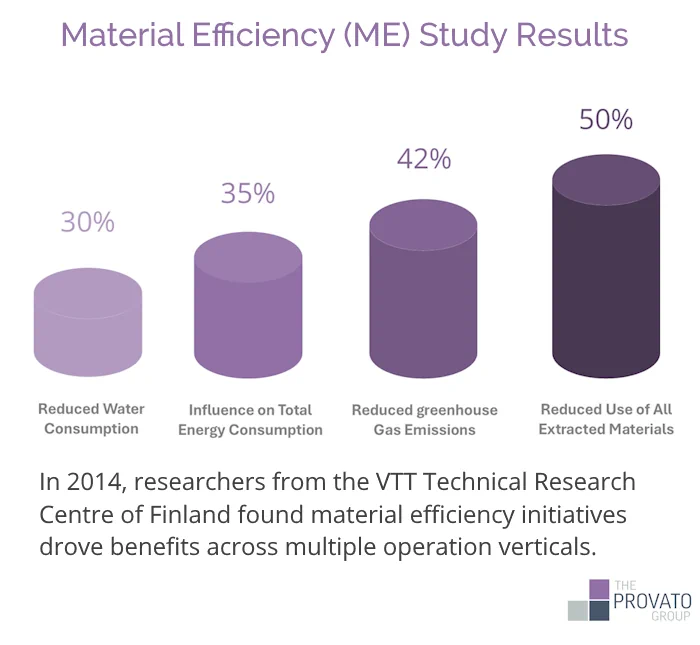
Material efficiency (ME) initiatives drive benefits across operations, economic performance, and sustainability using strategies such as higher segregation of residual materials, lean management, process optimization, and circular economy practices. In addition, training programs that focus on lean manufacturing and process analysis have been shown to significantly improve ME by educating employees on waste prevention and sustainability.
In a 2014 study, researchers from the VTT Technical Research Centre of Finland demonstrated that material efficiency efforts could save up to 30% of water consumption and influence 42% of final energy consumption, 35% of greenhouse gas emissions, and 50% of all extracted materials.

Step 4: Institute Statistical Process Control (SPC)
Statistical process control (SPC) uses data and control charts to monitor important production metrics, identify trends or anomalies in real-time, detect issues early, allowing for quick corrective actions to maintain consistent quality and reduce waste. The advent and inclusion of industry 4.0 technologies alongside custom software development to integrate those platforms have made SPC an important methodology for streamlining production systems.
Researchers from the Universiti Malaysia Pahang studied the integration between the Statistical Process Control (SPC), Overall Equipment Efficiency (OEE), and Autonomous Maintenance (AM) on production capability. The results of their 2015 study showed a reduction of defect rates by 8.49% (from 14.61% to 6.12%), cutting machine breakdown time by 1,341 minutes (from 2,502 to 1,161 minutes), and increasing Overall Equipment Effectiveness (OEE) by 6.49% (from 22.12% to 28.61%), despite initial employee unfamiliarity with equipment loss mechanisms.


Step 5: Evaluate and Improve Energy Efficiency
For production firms looking to boost efficiency, a focused energy strategy has proven to be a high-impact starting point. Research has consistently shown that leveraging purpose-specific software to integrate industry 4.0 technologies, along with systematic approaches to energy management can yield significant results.
A 2018 comprehensive analysis of nearly two decades of peer-reviewed literature (58 articles in total) published between 1998-2016 by researchers at Norway’s Arctic University found that when energy audits where used, they resulted in approximately 50% adoption rate of recommended projects. According to the research done by Mette Talseth Solnørdal and Lene Foss, these adoptions were primarily driven by organizational leadership and economic factors, which accounted for 75% of implementation decisions.
Main Driver of Energy Efficiency Initiatives
Solnørdal, M.T.; Foss, L. Closing the Energy Efficiency Gap—A Systematic Review of Empirical Articles on Drivers to Energy Efficiency in Manufacturing Firms.
| Driver | Percentage |
|---|---|
| Organizational & Management | 45% |
| Economic | 30% |
| Market | 15% |
| Policy Instruments | 10% |
Research has also shown a clear hierarchy (processes > design) in where producers can find the most substantial energy savings. When organizations implement the energy reduction in manufacturing process chains (E-MPC) framework, operational improvements emerge as the primary efficiency driver – delivering energy savings of up to 10% per manufactured part. While design modifications also contribute to energy reduction, their impact is more modest, typically yielding around 2% savings per part.
Step 6: Modernize Operations with Custom Manufacturing Software and Industry 4.0 Technology
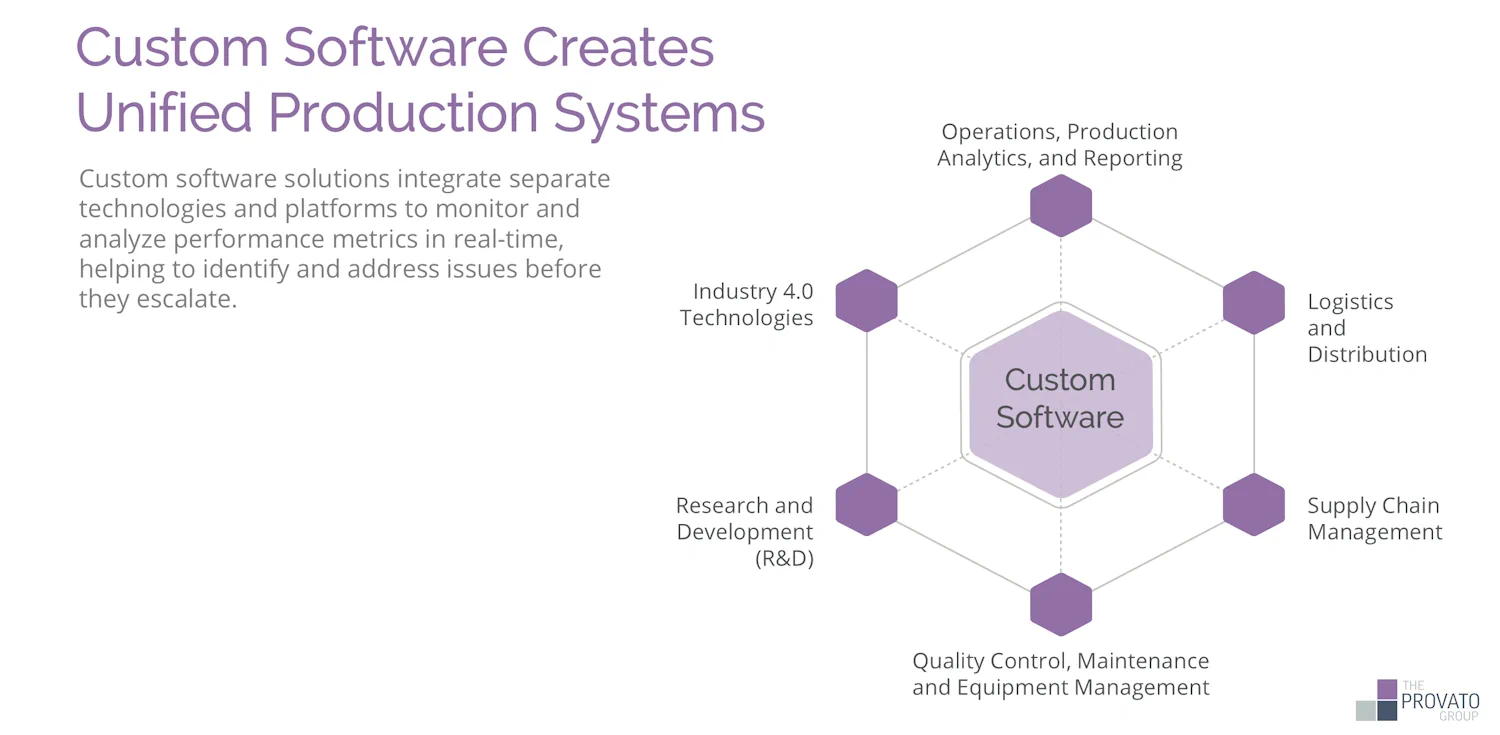
Industry 4.0 technologies such as Internet of Things (IoT), Artificial Intelligence (AI), and big data analytics work in conjunction with custom software to create a unified ecosystem of information about plant operations. Custom software solutions can integrate these technologies to monitor and analyze performance metrics in real-time, helping to identify and address issues before they escalate – much like in case of the 2015 study from the Universiti Malaysia Pahang where implementing Autonomous Maintenance (AM) has significantly improved manufacturing efficiency and overall equipment effectiveness.
A 2023 study from Cranfield University by Konstantinos Salonitis that covered 20 years of research found that system interoperability remains a key hurdle for firms looking to leverage industry 4.0 technologies. To address this, firms will often seek out custom manufacturing software development services to build systems that are adaptable, autonomous, and create an agile manufacturing environment capable of responding quickly to dynamic business needs.
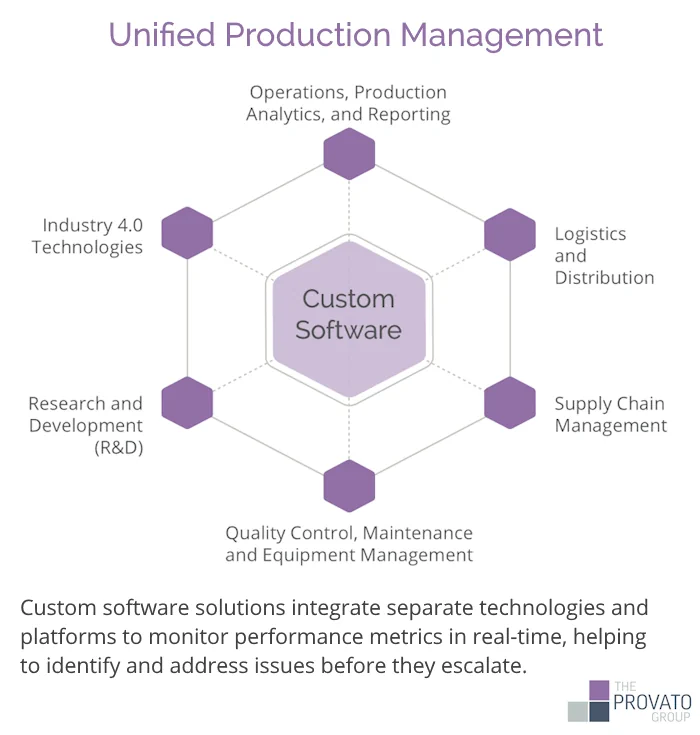
Your Factory, Your Software: Building the Perfect Fit
Our teams builds secure, robust, scalable platforms that allow manufacturers to unify legacy systems with new Industry 4.0 technologies. Our solutions fill in the gaps left by off-the-software, one-size-fits-all software packages to drive meaningful business results. The research from this article demonstrated that:
Custom manufacturing software helped reduce defect rates by 8.49% and cut machine breakdown time nearly in half, from 2,502 to 1,161 minutes.
Firms integrating Industry 4.0 technologies through custom solutions have achieved up to 30% increases in output without increasing input costs.
Energy efficiency initiatives supported by purpose-built software have delivered up to 10% savings per manufactured part.
The evidence is clear: manufacturing efficiency is key to maintaining competitiveness, and custom manufacturing software serves as the cornerstone for achieving world-class firm performance.
Can Our Custom, Integrated Solutions Help You Optimize Your Manufacturing Efficiency?
Our Software development team specializes in all aspects of creating and supporting applications that streamline your manufacturing processes through process-specific intelligence and optimization, seamless systems integration, and scalable performance solutions.
