



By Jon Lee, a Google-certified digital expert with 12+ years experience who brings depth and creative storytelling to emerging technology topics.
Reviewed By Brian McCracken, AI Strategy Expert at The Provato Group, combining AI/machine learning and frontend development to create intelligent, discoverable web experiences.
March, 2026
Application modernization challenges range from addressing technical debt in your legacy systems to navigating data migration and integration difficulties. To mitigate these obstacles, businesses must develop a structured and well-governed approach that balances innovation with continuity to help ensure a smooth modernization process.
But the challenges of modernization are worth the investment, time, and effort. Legacy systems might feel tried-and-true. According to a 2024 Forbes report, over 70% of Fortune 500 companies still rely on mainframes despite the rise of cloud computing. But these same legacy systems are vulnerable and outdated, with IBM reporting in 2023 that 60% of major enterprise breaches involved legacy systems being part of the vulnerabilities exploited.
Modernization does more than resolve security vulnerabilities. An organization with modernized applications can also count on having greater agility, fewer bottlenecks in processes and workflows, and improved performance and uptime. With recent developments, AI can be used in modernization to realize these benefits more quickly, and normally at a lower cost.
Overview of Application Modernization Challenges
In this guide, you’ll learn about:
- Understanding Legacy System Complexity
- Cost and Budget Constraints in Modernization
- Data Migration Risks and Security Concerns
- Integration Challenges with Modern Architectures
- Addressing Skills Gaps and Organizational Readiness
- Maintaining Business Continuity During Modernization
- Choosing the Right Modernization Strategy
- How AI Provides Value in Legacy Modernization
Understanding Legacy System Complexity
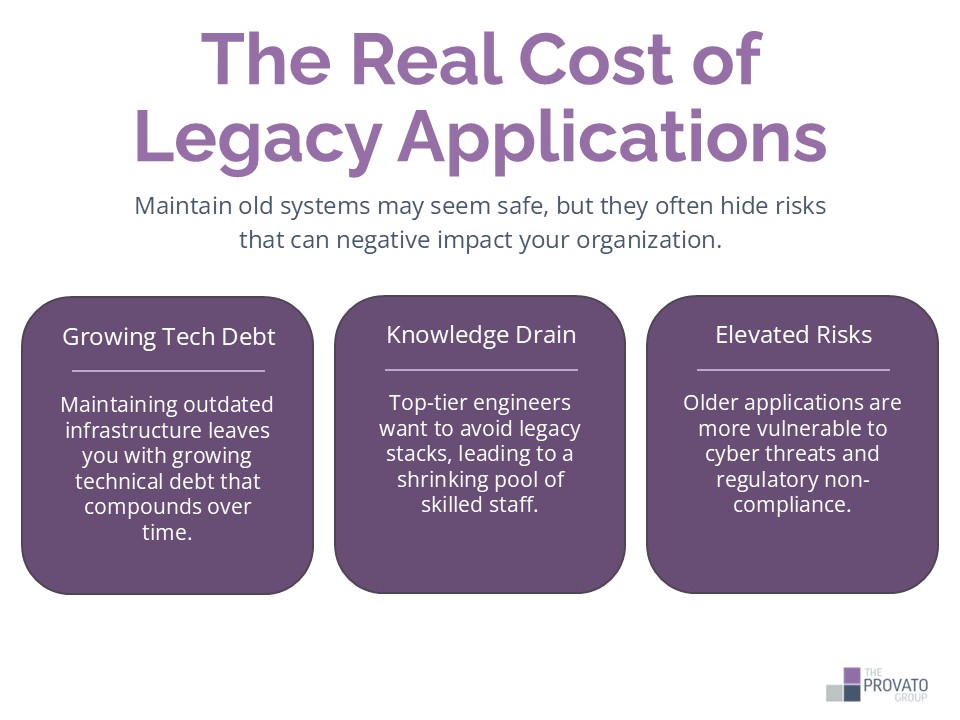
Legacy system complexity refers to systems built on outdated programming languages, monolithic architecture, or unsupported platforms that lead to technical debt accumulation and modernization challenges.
Legacy systems accumulate technical debt over time. A common form comes from short-term fixes and patchwork integrations. While these quick fixes solve immediate problems, they create compounding inefficiencies that make it difficult to maintain, scale, or secure applications.
Other technical debt includes hidden dependencies, undocumented workflows, and tightly coupled components that make modernization costly and difficult. Modernizing these systems often requires extensive refactoring, testing, and integration work.
Technical debt also increases maintenance costs, reduces system flexibility, and slows innovation because teams must spend time maintaining obsolete code instead of delivering new features.
Understanding the complexity of your legacy systems is the first step toward building a successful modernization strategy.
How AI Can Help
AI is changing how most of these concerns are meet. AI-augmented modernization uses automated code analysis, discovery, and dependency mapping while traditional application modernization requires that these tasks be performed manually.
That doesn’t mean that AI does all the work.AI is best used for understanding, documentation, and implementation, but a team of engineers are still need to make the important architectural decisions and validate the AI output with tests and additional runtime evidence.
When AI is leveraged to automate time consuming tasks involved with understanding a system’s complexity, engineers can focus on architecture and execution which ultimately results in lower costs and faster modernization completion times.
Cost and Budget Constraints in Modernization
Cost and budget constraints are major challenges in application modernization. These financial considerations often include:
- Upfront Costs
- Lifecycle Economics
- Calculating ROI
Upfront Costs
Upfront costs include refactoring legacy code, hiring specialized developers such as cloud or DevOps engineers, implementing CI/CD pipelines, and migrating infrastructure to the cloud. Organizations may also incur costs from software licenses, hardware purchases, or SaaS subscriptions.
These costs become one of the most visible barriers to modernization, particularly for organizations managing multiple legacy systems.
Lifecycle Economics
Lifecycle economics refers to the long-term financial burden of operating and maintaining legacy applications. These costs include ongoing maintenance overhead, rising infrastructure costs, and inefficient deployment processes.
During modernization, organizations may also incur parallel operating costs while maintaining both legacy and modern systems simultaneously.
All of these contribute to the overall Total Cost of Ownership (TCO) of legacy systems.
Over time, modernization can significantly reduce TCO by minimizing manual maintenance, improving performance, automating deployments, and leveraging scalable cloud infrastructure.
Calculating ROI
Calculating ROI involves comparing the total investment required for modernization with both quantifiable cost reductions and long-term benefits such as:
- Faster time-to-market
- Enhanced customer experience
- Lower downtime
- Greater scalability
Achieving these benefits requires disciplined planning, clearly defined KPIs, and phased execution to ensure modernization efforts remain within budget and deliver the expected outcomes.
Data Migration Risks and Security Concerns
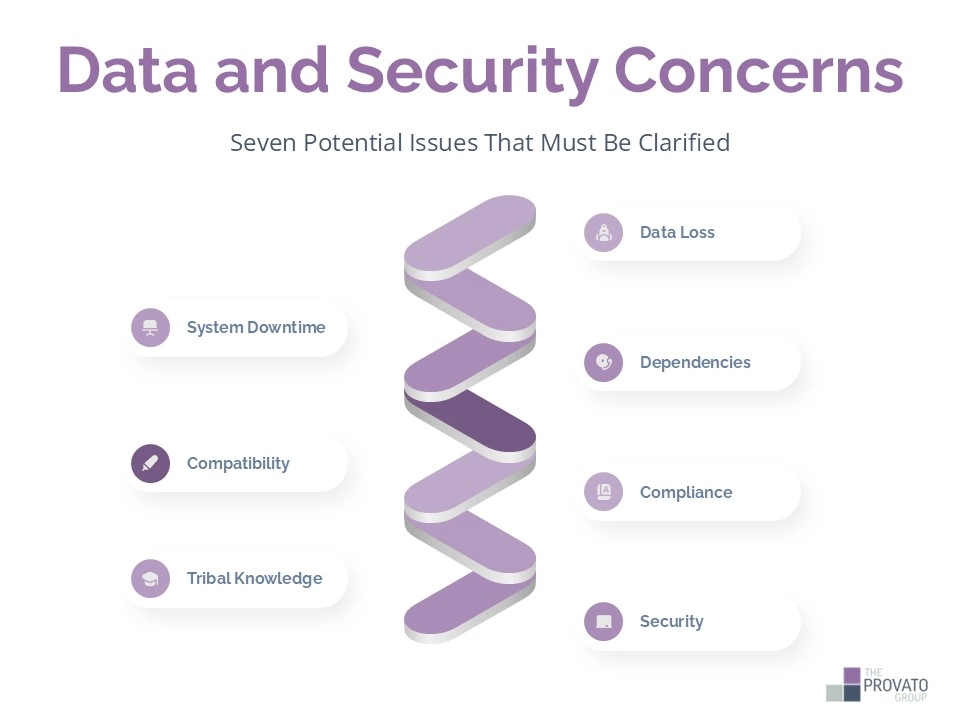
Data migration is one of the most complex and risk-sensitive phases of modernization. Organizations must carefully manage issues such as:
- Data loss
- System downtime
- Undocumented dependencies
- User compatibility issues
- Compliance failures
- Black-box legacy knowledge
- Security vulnerabilities
Data Loss
Data loss or corruption can occur during migration due to transformation errors, network failures, or incompatible encoding between systems. Poor-quality legacy data such as duplicates or inconsistent formats can also introduce complications.
System Downtime
Migration activities can introduce downtime that disrupts operations. Organizations must estimate and plan for downtime carefully, often with the help of experienced migration specialists or tools.
Undocumented Dependencies
Legacy systems often contain hidden dependencies that may break during migration. Undocumented middleware, background processes, or integrations can create unexpected failures in the new environment.
User Compatibility Issues
Changes to data structures or workflows may create usability challenges for end users, slowing adoption and potentially encouraging shadow IT solutions.
Compliance Failures
Data migrations must comply with regulations such as GDPR, CCPA, and HIPAA. Failure to meet regulatory requirements can result in significant legal and financial penalties.
Security Breach Vulnerabilities
Migration processes can introduce security vulnerabilities if permissions are misconfigured or encryption is not properly applied during data transfers.
Integration Challenges with Modern Architectures
Modern architectures often rely on microservices, APIs, and cloud-native platforms. Integrating legacy systems with these modern environments introduces new technical complexities.
Transitioning from Monolithic to Microservices Architecture
Legacy monolithic applications typically contain tightly coupled codebases and shared databases with complex dependencies.
To transition successfully to microservices, organizations must:
- Identify bounded contexts and business domains
- Decouple shared data layers
- Refactor tightly integrated dependencies
- Establish independent deployment pipelines
API-Driven Strategy
An API-driven strategy allows legacy and modern systems to communicate effectively. However, organizations must address challenges such as API governance, version control, endpoint security, and performance monitoring.
Well-designed APIs enable incremental modernization strategies such as the Strangler Fig Pattern, which gradually replaces legacy functionality with modern services.
Cloud-Native Integration
Cloud-native environments introduce additional technical considerations, including:
- Infrastructure as Code (IaC)
- CI/CD pipelines
- Container orchestration
- Automated scaling
- Distributed monitoring
Addressing Skill Gaps and Organizational Readiness
Successful modernization requires organizations to address both technical skills and organizational readiness.
Common challenges include:
- Shortage of cloud-native and DevOps talent
- Upskilling internal teams
- Cultural resistance to change
- Leadership alignment and stakeholder buy-in
Maintaining Business Continuity During Modernization
Legacy systems often support mission-critical business functions. Modernization must therefore be carefully managed to avoid operational disruption.
Key continuity considerations include:
- Risk of operational disruption
- Choosing between phased or big-bang modernization
- Parallel system deployment
- Rollback and contingency planning
Potential Solutions
| Approach | Description |
|---|---|
| Phased Modernization | Introduces changes gradually, allowing organizations to validate each stage before proceeding. This reduces risk and enables incremental value delivery. |
| Parallel System Deployment | Running legacy and modern systems simultaneously allows organizations to compare outputs, validate data accuracy, and migrate users gradually. |
| Rollback and Contingency Planning | Rollback strategies ensure that systems can quickly return to a stable state if problems occur during deployment. |
Choosing the Right Modernization Strategy
Selecting the appropriate modernization strategy depends on each application’s technical requirements, business value, risk tolerance, and timeline constraints.
The AWS migration framework commonly describes six modernization paths known as the 6 Rs:
- Rehost (Lift and Shift)
- Replatform
- Refactor
- Rearchitect
- Rebuild
- Replace
Rehost (Lift and Shift)
Rehosting moves applications to the cloud with minimal changes. This approach is fast and cost-effective but does not eliminate technical debt.
Replatform
Replatforming introduces minor optimizations such as managed databases or container platforms while maintaining the existing application architecture.
Refactor
Refactoring improves code quality and maintainability without fundamentally changing the application structure.
Rearchitect
Rearchitecting redesigns applications to align with modern architectures such as microservices or cloud-native frameworks.
Rebuild
Rebuilding involves redeveloping the application from scratch while preserving core business requirements.
Replace
Replacing retires the legacy system and adopts a commercial off-the-shelf (COTS) or SaaS solution.
How AI Changes Modernization Strategies and Delivers Value
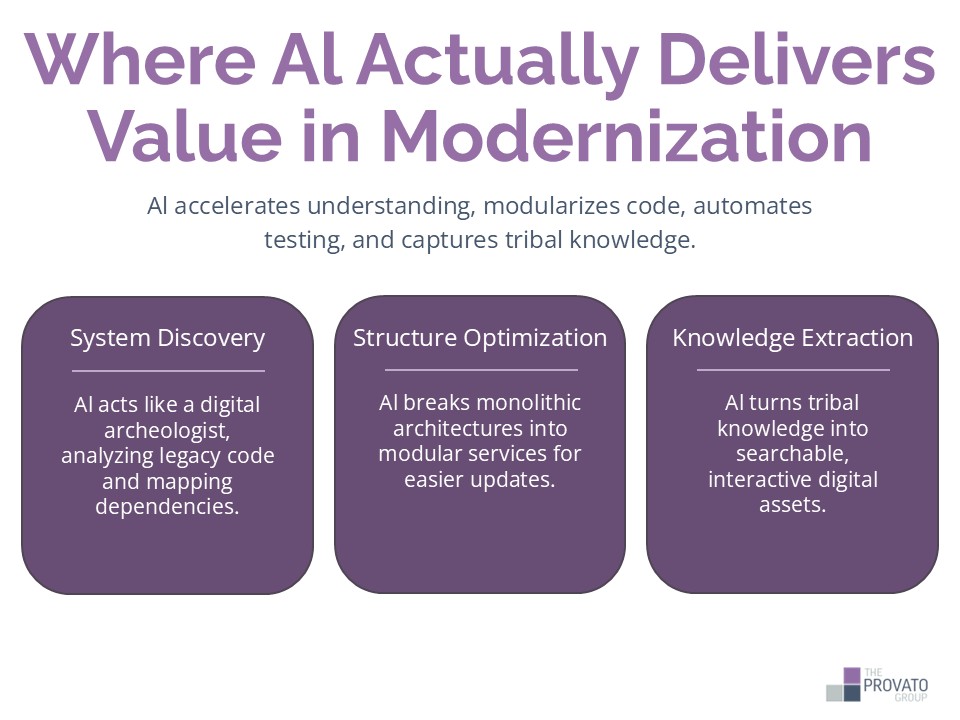
AI is changing application modernization strategies used by many development teams. It’s value is not in its writing of code, although that’s a big part of it, but in how it accelerates the understanding of complex and messy legacy applications.
Modernization efforts often fail because teams are afraid to touch what they don’t understand. It’s the tribal knowledge trap. AI solves this system discovery problem by acting as a digital archeologist, analyzing code and performing dependency mapping to spell out how the software truly works, not how 20 year old unmaintained documentation says it should. AI can find dependencies in legacy applications quickly, allowing developers to cut testing time by 50% in many cases. It gives software engineers the superpower of knowing what will break if a single line of code is changed, which according to the 2023 and 2024 surveys by DevOps.com, drives faster project delivery times for 81% of respondents.
Considering a Custom Software Developer for AI-Driven Legacy Modernization
Legacy application modernization requires structured assessments, technical planning, and disciplined execution.
Organizations may benefit from working with experienced custom software developers who specialize in legacy modernization. These partners can help evaluate technical debt, define modernization roadmaps, and execute migration strategies effectively.
As skilled development partner, we guides organizations through modernization while minimizing risk and promoting long term success by appropriately using AI where it is most beneficial.